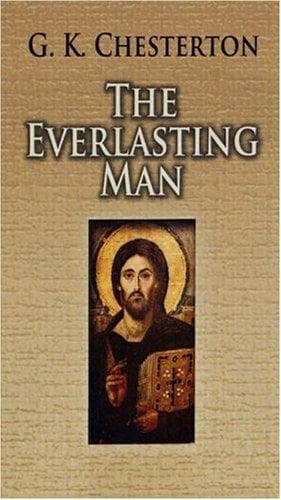
The Everlasting ManChesterton, G. K. (Gilbert Keith)
Religion
The Everlasting Man
Chesterton, G. K. (Gilbert Keith)
Catholic Church -- Apologetic works; Christianity and other religions; Religion
I confess I doubt the whole theory of the dissemination of myths or (as
it commonly is) of one myth. It is true that something in our nature and
conditions makes many stories similar; but each of them may be original.
One man does not borrow the story from the other man, though he may tell
it from the same motive as the other man. It would be easy to apply the
whole argument about legend to literature; and turn it into a vulgar
monomania of plagiarism. I would undertake to trace a notion like that
of the Golden Bough through individual modern novels as easily as
through communal and antiquated myths. I would undertake to find
something like a bunch of flowers figuring again and again from the
fatal bouquet of Becky Sharpe to the spray of roses sent by the Princess
of Ruritania. But though these flowers may spring from the same soil, it
is not the same faded flower that is flung from hand to hand. Those
flowers are always fresh.
The true origin of all the myths has been discovered much too often.
There are too many keys to mythology, as there are too many cryptograms
in Shakespeare. Everything is phallic; everything is totemistic;
everything is seed-time and harvest; everything is ghosts and
grave-offerings; everything is the golden bough of sacrifice; everything
is the sun and moon; everything is everything. Every folk-lore student
who knew a little more than his own monomania, every man of wider
reading and critical culture like Andrew Lang, has practically confessed
that the bewilderment of these things left his brain spinning. Yet the
whole trouble comes from a man trying to look at these stories from the
outside, as if they were scientific objects. He has only to look at them
from the inside, and ask himself how he would begin a story. A story may
start with anything and go anywhere. It may start with a bird without
the bird being a totem; it may start with the sun without being a solar
myth. It is said there are only ten plots in the world; and there will
certainly be common and recurrent elements. Set ten thousand children
talking at once, and telling tarradiddles about what they did in the
wood; and it will not be hard to find parallels suggesting sun-worship
or animal-worship. Some of the stories may be pretty and some silly and
some perhaps dirty; but they can only be judged as stories. In the
modern dialect, they can only be judged aesthetically. It is strange
that aesthetics, or mere feeling, which is now allowed to usurp where
it has no rights at all, to wreck reason with pragmatism and morals with
anarchy, is apparently not allowed to give a purely aesthetic judgment
on what is obviously a purely aesthetic question. We may be fanciful
about everything except fairy-tales.
Public-domain text, read in full here on John Shaqi.
Reviews
Reviews
No reviews yet
Be the first to share your thoughts on this work.
Elsewhere in the archive
Join the Discussion
Join the discussion
Sign in to leave a comment or review.
Sign InorCreate an account