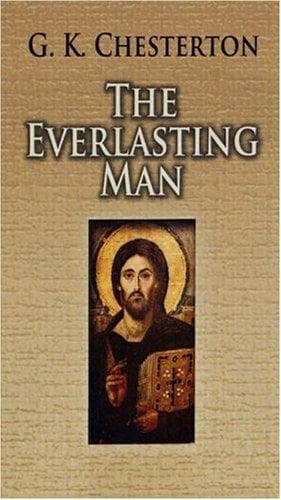
The Everlasting ManChesterton, G. K. (Gilbert Keith)
Religion
The Everlasting Man
Chesterton, G. K. (Gilbert Keith)
Catholic Church -- Apologetic works; Christianity and other religions; Religion
Now the first fact is that the most simple people have the most subtle
ideas. Everybody ought to know that, for everybody has been a child.
Ignorant as a child is, he knows more than he can say and feels not only
atmospheres but fine shades. And in this matter there are several fine
shades. Nobody understands it who has not had what can only be called
the ache of the artist to find some sense and some story in the
beautiful things he sees; his hunger for secrets and his anger at any
tower or tree escaping with its tale untold. He feels that nothing is
perfect unless it is personal. Without that the blind unconscious beauty
of the world stands in its garden like a headless statue. One need only
be a very minor poet to have wrestled with the tower or the tree until
it spoke like a titan or a dryad. It is often said that pagan mythology
was a personification of the powers of nature. The phrase is true in a
sense, but it is very unsatisfactory; because it implies that the forces
are abstractions and the personification is artificial. Myths are not
allegories. Natural powers are not in this case abstractions. It is not
as if there were a God of Gravitation. There may be a genius of the
waterfall; but not of mere falling, even less than of mere water. The
impersonation is not of something impersonal. The point is that the
personality perfects the water with significance. Father Christmas is
not an allegory of snow and holly; he is not merely the stuff called
snow afterwards artificially given a human form, like a snow man. He is
something that gives a new meaning to the white world and the
evergreens; so that snow itself seems to be warm rather than cold. The
test therefore is purely imaginative. But imaginative does not mean
imaginary. It does not follow that it is all what the moderns call
subjective, when they mean false. Every true artist does feel,
consciously or unconsciously, that he is touching transcendental truths;
that his images are shadows of things seen through the veil. In other
words, the natural mystic does know that there is something _there_;
something behind the clouds or within the trees; but he believes that
the pursuit of beauty is the way to find it; that imagination is a sort
of incantation that can call it up.
Public-domain text, read in full here on John Shaqi.
Reviews
Reviews
No reviews yet
Be the first to share your thoughts on this work.
Elsewhere in the archive
Join the Discussion
Join the discussion
Sign in to leave a comment or review.
Sign InorCreate an account