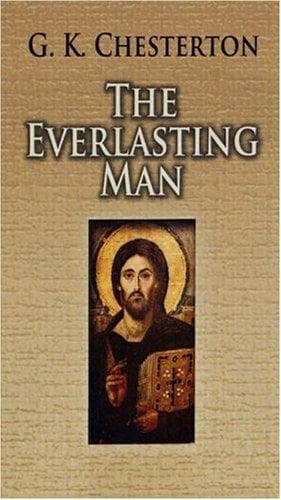
The Everlasting ManChesterton, G. K. (Gilbert Keith)
Religion
The Everlasting Man
Chesterton, G. K. (Gilbert Keith)
Catholic Church -- Apologetic works; Christianity and other religions; Religion
But it is the wrong way of dealing with a cloud; and
is liable to leave the learned in the condition of Polonius, only too
ready to think it like a weasel, or very like a whale.
Two facts follow from this psychology of day-dreams, which must be kept
in mind throughout their development in mythologies and even religions.
First, these imaginative impressions are often strictly local. So far
from being abstractions turned into allegories, they are often images
almost concentrated into idols. The poet feels the mystery of a
particular forest; not of the science of afforestation or the department
of woods and forests. He worships the peak of a particular mountain, not
the abstract idea of altitude. So we find the god is not merely water
but often one special river; he may be the sea because the sea is single
like a stream; the river that runs round the world. Ultimately doubtless
many deities are enlarged into elements; but they are something more
than omnipresent. Apollo does not merely dwell wherever the sun shines;
his home is on the rock of Delphi. Diana is great enough to be in three
places at once, earth and heaven and hell, but greater is Diana of the
Ephesians. This localised feeling has its lowest form in the mere fetish
or talisman, such as millionaires put on their motor-cars. But it can
also harden into something like a high and serious religion, where it is
connected with high and serious duties; into the gods of the city or
even the gods of the hearth.
The second consequence is this: that in these pagan cults there is every
shade of sincerity--and insincerity. In what sense exactly did an
Athenian really think he had to sacrifice to Pallas Athene? What scholar
is really certain of the answer? In what sense did Dr. Johnson really
think that he had to touch all the posts in the street or that he had to
collect orange-peel? In what sense does a child really think that he
ought to step on every alternate paving-stone? Two things are at least
fairly clear. First, in simpler and less self-conscious times these
forms could become more solid without really becoming more serious.
Day-dreams could be acted in broad daylight, with more liberty of
artistic expression; but still perhaps with something of the light step
of the somnambulist. Wrap Dr. Johnson in an antique mantle, crown him
(by his kind permission) with a garland, and he will move in state under
those ancient skies of morning; touching a series of sacred posts
carved with the heads of the strange terminal gods, that stand at the
limits of the land and of the life of man. Make the child free of the
marbles and mosaics of some classic temple, to play on a whole floor
inlaid with squares of black and white; and he will willingly make this
fulfilment of his idle and drifting day-dream the clear field for a
grave and graceful dance. But the posts and the paving-stones are little
more and little less real than they are under modern limits. They are
Public-domain text, read in full here on John Shaqi.
Reviews
Reviews
No reviews yet
Be the first to share your thoughts on this work.
Elsewhere in the archive
Join the Discussion
Join the discussion
Sign in to leave a comment or review.
Sign InorCreate an account