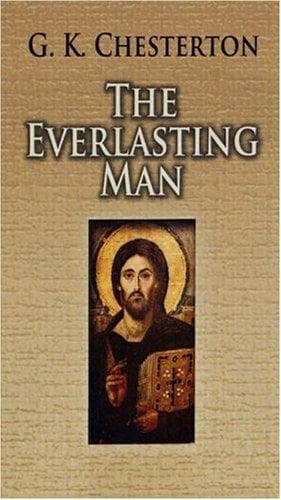
The Everlasting ManChesterton, G. K. (Gilbert Keith)
Religion
The Everlasting Man
Chesterton, G. K. (Gilbert Keith)
Catholic Church -- Apologetic works; Christianity and other religions; Religion
not really much more serious for being taken seriously. They have the
sort of sincerity that they always had; the sincerity of art as a symbol
that expresses very real spiritualities under the surface of life. But
they are only sincere in the same sense as art; not sincere in the same
sense as morality. The eccentric’s collection of orange-peel may turn to
oranges in a Mediterranean festival or to golden apples in a
Mediterranean myth. But they are never on the same plane with the
difference between giving the orange to a blind beggar and carefully
placing the orange-peel so that the beggar may fall and break his leg.
Between these two things there is a difference of kind and not of
degree. The child does not think it wrong to step on the paving-stone as
he thinks it wrong to step on the dog’s tail. And it is very certain
that whatever jest or sentiment or fancy first set Johnson touching the
wooden posts, he never touched wood with any of the feeling with which
he stretched out his hands to the timber of that terrible tree, which
was the death of God and the life of man.
As already noted, this does not mean that there was no reality or even
no religious sentiment in such a mood. As a matter of fact the Catholic
Church has taken over with uproarious success the whole of this popular
business of giving people local legends and lighter ceremonial
movements. In so far as all this sort of paganism was innocent and in
touch with nature, there is no reason why it should not be patronised by
patron saints as much as by pagan gods. And in any case there are
degrees of seriousness in the most natural make-believe. There is all
the difference between fancying there are fairies in the wood, which
often only means fancying a certain wood as fit for fairies, and really
frightening ourselves until we will walk a mile rather than pass a house
we have told ourselves is haunted. Behind all these things is the fact
that beauty and terror are very real things and related to a real
spiritual world; and to touch them at all, even in doubt or fancy, is to
stir the deep things of the soul. We all understand that and the pagans
understood it. The point is that paganism did not really stir the soul
except with these doubts and fancies; with the consequence that we
to-day can have little beyond doubts and fancies about paganism. All the
best critics agree that all the greatest poets, in pagan Hellas for
example, had an attitude towards their gods which is quite queer and
puzzling to men in the Christian era. There seems to be an admitted
conflict between the god and the man; but everybody seems to be doubtful
about which is the hero and which is the villain. This doubt does not
merely apply to a doubter like Euripides in the Bacchae; it applies to a
moderate conservative like Sophocles in the Antigone; or even to a
regular Tory and reactionary like Aristophanes in the Frogs. Sometimes
it would seem that the Greeks believed above all things in reverence,
Public-domain text, read in full here on John Shaqi.
Reviews
Reviews
No reviews yet
Be the first to share your thoughts on this work.
Elsewhere in the archive
Join the Discussion
Join the discussion
Sign in to leave a comment or review.
Sign InorCreate an account