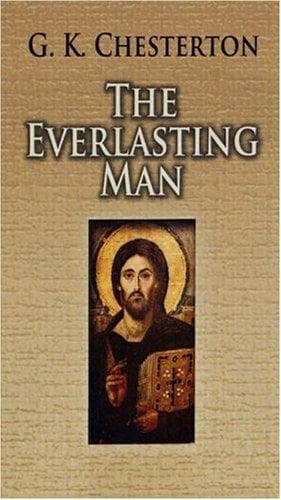
The Everlasting ManChesterton, G. K. (Gilbert Keith)
Religion
The Everlasting Man
Chesterton, G. K. (Gilbert Keith)
Catholic Church -- Apologetic works; Christianity and other religions; Religion
only they had nobody to revere. But the point of the puzzle is this:
that all this vagueness and variation arise from the fact that the whole
thing began in fancy and in dreaming; and that there are no rules of
architecture for a castle in the clouds.
This is the mighty and branching tree called mythology which ramifies
round the whole world, whose remote branches under separate skies bear
like coloured birds the costly idols of Asia and the half-baked fetishes
of Africa and the fairy kings and princesses of the folk-tales of the
forests, and buried amid vines and olives the Lares of the Latins, and
carried on the clouds of Olympus the buoyant supremacy of the gods of
Greece. These are the myths: and he who has no sympathy with myths has
no sympathy with men. But he who has most sympathy with myths will most
fully realise that they are not and never were a religion, in the sense
that Christianity or even Islam is a religion. They satisfy some of the
needs satisfied by a religion; and notably the need for doing certain
things at certain dates; the need of the twin ideas of festivity and
formality. But though they provide a man with a calendar, they do not
provide him with a creed. A man did not stand up and say ‘I believe in
Jupiter and Juno and Neptune,’ etc., as he stands up and says ‘I believe
in God the Father Almighty’ and the rest of the Apostles’ Creed. Many
believed in some and not in others, or more in some and less in others,
or only in a very vague poetical sense in any. There was no moment when
they were all collected into an orthodox order which men would fight and
be tortured to keep intact. Still less did anybody ever say in that
fashion: ‘I believe in Odin and Thor and Freya,’ for outside Olympus
even the Olympian order grows cloudy and chaotic. It seems clear to me
that Thor was not a god at all but a hero. Nothing resembling a religion
would picture anybody resembling a god as groping like a pigmy in a
great cavern, that turned out to be the glove of a giant. That is the
glorious ignorance called adventure. Thor may have been a great
adventurer; but to call him a god is like trying to compare Jehovah with
Jack and the Beanstalk. Odin seems to have been a real barbarian chief,
possibly of the Dark Ages after Christianity. Polytheism fades away at
its fringes into fairy-tales or barbaric memories; it is not a thing
like monotheism as held by serious monotheists. Again it does satisfy
the need to cry out on some uplifted name or some noble memory in
moments that are themselves noble and uplifted; such as the birth of a
child or the saving of a city. But the name was so used by many to whom
it was only a name. Finally it did satisfy, or rather it partially
satisfied, a thing very deep in humanity indeed; the idea of
surrendering something as the portion of the unknown powers; of pouring
out wine upon the ground, of throwing a ring into the sea; in a word, of
sacrifice. It is the wise and worthy idea of not taking our advantage to
Public-domain text, read in full here on John Shaqi.
Reviews
Reviews
No reviews yet
Be the first to share your thoughts on this work.
Elsewhere in the archive
Join the Discussion
Join the discussion
Sign in to leave a comment or review.
Sign InorCreate an account