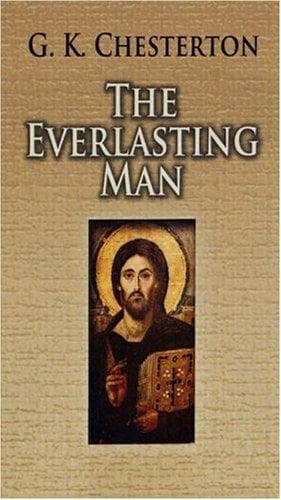
The Everlasting ManChesterton, G. K. (Gilbert Keith)
Religion
The Everlasting Man
Chesterton, G. K. (Gilbert Keith)
Catholic Church -- Apologetic works; Christianity and other religions; Religion
The substance of all such paganism may be summarised thus. It is an
attempt to reach the divine reality through the imagination alone; in
its own field reason does not restrain it at all. It is vital to the
view of all history that reason is something separate from religion even
in the most rational of these civilisations. It is only as an
afterthought, when such cults are decadent or on the defensive, that a
few Neo-Platonists or a few Brahmins are found trying to rationalise
them, and even then only by trying to allegorise them. But in reality
the rivers of mythology and philosophy run parallel and do not mingle
till they meet in the sea of Christendom. Simple secularists still talk
as if the Church had introduced a sort of schism between reason and
religion. The truth is that the Church was actually the first thing that
ever tried to combine reason and religion. There had never before been
any such union of the priests and the philosophers. Mythology, then,
sought God through the imagination; or sought truth by means of beauty,
in the sense in which beauty includes much of the most grotesque
ugliness. But the imagination has its own laws and therefore its own
triumphs, which neither logicians nor men of science can understand. It
remained true to that imaginative instinct through a thousand
extravagances, through every crude cosmic pantomime of a pig eating the
moon or the world being cut out of a cow, through all the dizzy
convolutions and mystic malformations of Asiatic art, through all the
stark and staring rigidity of Egyptian and Assyrian portraiture, through
every kind of cracked mirror of mad art that seemed to deform the world
and displace the sky, it remained true to something about which there
can be no argument; something that makes it possible for some artist of
some school to stand suddenly still before that particular deformity and
say, ‘My dream has come true.’ Therefore do we all in fact feel that
pagan or primitive myths are infinitely suggestive, so long as we are
wise enough not to inquire what they suggest. Therefore we all feel what
is meant by Prometheus stealing fire from heaven, until some prig of a
pessimist or progressive person explains what it means. Therefore we all
know the meaning of Jack and the Beanstalk, until we are told. In this
sense it is true that it is the ignorant who accept myths, but only
because it is the ignorant who appreciate poems. Imagination has its own
laws and triumphs; and a tremendous power began to clothe its images,
whether images in the mind or in the mud, whether in the bamboo of the
South Sea Islands or the marble of the mountains of Hellas. But there
was always a trouble in the triumph, which in these pages I have tried
to analyse in vain; but perhaps I might in conclusion state it thus.
Public-domain text, read in full here on John Shaqi.
Reviews
Reviews
No reviews yet
Be the first to share your thoughts on this work.
Elsewhere in the archive
Join the Discussion
Join the discussion
Sign in to leave a comment or review.
Sign InorCreate an account