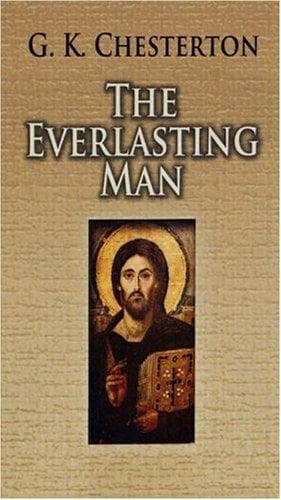
The Everlasting ManChesterton, G. K. (Gilbert Keith)
Religion
The Everlasting Man
Chesterton, G. K. (Gilbert Keith)
Catholic Church -- Apologetic works; Christianity and other religions; Religion
The crux and crisis is that man found it natural to worship; even
natural to worship unnatural things. The posture of the idol might be
stiff and strange; but the gesture of the worshipper was generous and
beautiful. He not only felt freer when he bent; he actually felt taller
when he bowed. Henceforth anything that took away the gesture of worship
would stunt and even maim him for ever. Henceforth being merely secular
would be a servitude and an inhibition. If man cannot pray he is gagged;
if he cannot kneel he is in irons. We therefore feel throughout the
whole of paganism a curious double feeling of trust and distrust. When
the man makes the gesture of salutation and of sacrifice, when he pours
out the libation or lifts up the sword, he knows he is doing a worthy
and a virile thing. He knows he is doing one of the things for which a
man was made. His imaginative experiment is therefore justified. But
precisely because it began with imagination, there is to the end
something of mockery in it, and especially in the object of it. This
mockery, in the more intense moments of the intellect, becomes the
almost intolerable irony of Greek tragedy. There seems a disproportion
between the priest and the altar or between the altar and the god. The
priest seems more solemn and almost more sacred than the god. All the
order of the temple is solid and sane and satisfactory to certain parts
of our nature; except the very centre of it, which seems strangely
mutable and dubious, like a dancing flame. It is the first thought round
which the whole has been built; and the first thought is still a fancy
and almost a frivolity. In that strange place of meeting, the man seems
more statuesque than the statue. He himself can stand for ever in the
noble and natural attitude of the statue of the Praying Boy. But
whatever name be written on the pedestal, whether Zeus or Ammon or
Apollo, the god whom he worships is Proteus.
Public-domain text, read in full here on John Shaqi.
Reviews
Reviews
No reviews yet
Be the first to share your thoughts on this work.
Elsewhere in the archive
Join the Discussion
Join the discussion
Sign in to leave a comment or review.
Sign InorCreate an account