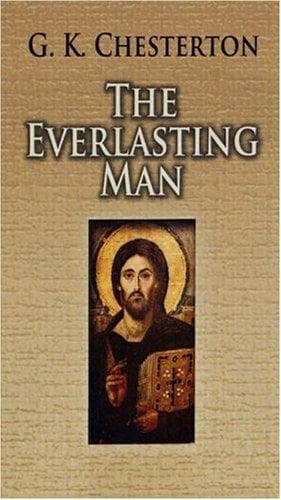
The Everlasting ManChesterton, G. K. (Gilbert Keith)
Religion
The Everlasting Man
Chesterton, G. K. (Gilbert Keith)
Catholic Church -- Apologetic works; Christianity and other religions; Religion
That is where all these things differed from religion in the reality in
which these different dimensions met or a sort of solid. They differed
from the reality not in what they looked like but in what they were. A
picture may look like a landscape; it may look in every detail exactly
like a landscape. The only detail in which it differs is that it is not
a landscape. The difference is only that which divides a portrait of
Queen Elizabeth from Queen Elizabeth. Only in this mythical and mystical
world the portrait could exist before the person; and the portrait was
therefore more vague and doubtful. But anybody who has felt and fed on
the atmosphere of these myths will know what I mean when I say that in
one sense they did not really profess to be realities. The pagans had
dreams about realities; and they would have been the first to admit, in
their own words, that some came through the gate of ivory and others
through the gate of horn. The dreams do indeed tend to be very vivid
dreams when they touch on those tender or tragic things, which can
really make a sleeper awaken with the sense that his heart has been
broken in his sleep. They tend continually to hover over certain
passionate themes of meeting and parting, of a life that ends in death
or a death that is the beginning of life. Demeter wanders over a
stricken world looking for a stolen child; Isis stretches out her arms
over the earth in vain to gather the limbs of Osiris; and there is
lamentation upon the hills for Atys and through the woods for Adonis.
There mingles with all such mourning the mystical and profound sense
that death can be a deliverer and an appeasement; that such death gives
us a divine blood for a renovating river and that all good is found in
gathering the broken body of the god. We may truly call these
foreshadowings; so long as we remember that foreshadowings are shadows.
And the metaphor of a shadow happens to hit very exactly the truth that
is very vital here. For a shadow is a shape; a thing which reproduces
shape but not texture. These things were something _like_ the real
thing; and to say that they were like is to say that they were
different. Saying something is like a dog is another way of saying it is
not a dog; and it is in this sense of identity that a myth is not a man.
Nobody really thought of Isis as a human being; nobody really thought of
Demeter as a historical character; nobody thought of Adonis as the
founder of a Church. There was no idea that any one of them had changed
the world; but rather that their recurrent death and life bore the sad
and beautiful burden of the changelessness of the world. Not one of them
was a revolution, save in the sense of the revolution of the sun and
moon. Their whole meaning is missed if we do not see that they mean the
shadows that we are and the shadows that we pursue. In certain
sacrificial and communal aspects they naturally suggest what sort of a
god might satisfy men; but they do not profess to be satisfied.
Public-domain text, read in full here on John Shaqi.
Reviews
Reviews
No reviews yet
Be the first to share your thoughts on this work.
Elsewhere in the archive
Join the Discussion
Join the discussion
Sign in to leave a comment or review.
Sign InorCreate an account