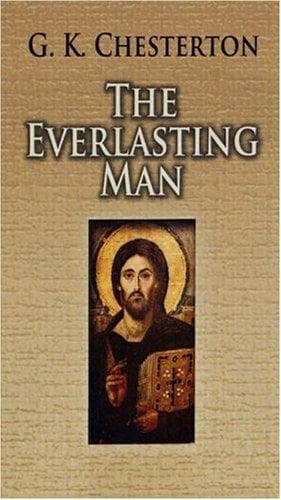
The Everlasting ManChesterton, G. K. (Gilbert Keith)
Religion
The Everlasting Man
Chesterton, G. K. (Gilbert Keith)
Catholic Church -- Apologetic works; Christianity and other religions; Religion
Any one
who says they do is a bad judge of poetry.
Those who talk about Pagan Christs have less sympathy with Paganism than
with Christianity. Those who call these cults ‘religions,’ and ‘compare’
them with the certitude and challenge of the Church have much less
appreciation than we have of what made heathenism human, or of why
classic literature is still something that hangs in the air like a song.
It is no very human tenderness for the hungry to prove that hunger is
the same as food. It is no very genial understanding of youth to argue
that hope destroys the need for happiness. And it is utterly unreal to
argue that these images in the mind, admired entirely in the abstract,
were even in the same world with a living man and a living polity that
were worshipped because they were concrete. We might as well say that a
boy playing at robbers is the same as a man in his first day in the
trenches; or that a boy’s first fancies about ‘the not impossible she’
are the same as the sacrament of marriage. They are fundamentally
different exactly where they are superficially similar; we might almost
say they are not the same even when they are the same. They are only
different because one is real and the other is not. I do not mean merely
that I myself believe that one is true and the other is not. I mean that
one was never meant to be true in the same sense as the other. The sense
in which it was meant to be true I have tried to suggest vaguely here,
but it is undoubtedly very subtle and almost indescribable. It is so
subtle that the students who profess to put it up as a rival to our
religion miss the whole meaning and purport of their own study. We know
better than the scholars, even those of us who are no scholars, what was
in that hollow cry that went forth over the dead Adonis and why the
Great Mother had a daughter wedded to death. We have entered more deeply
than they into the Eleusinian Mysteries and have passed a higher grade,
where gate within gate guarded the wisdom of Orpheus. We know the
meaning of all the myths. We know the last secret revealed to the
perfect initiate. And it is not the voice of a priest or a prophet
saying, ‘These things are.’ It is the voice of a dreamer and an idealist
crying, ‘Why cannot these things be?’
CHAPTER VI
THE DEMONS AND THE PHILOSOPHERS
Public-domain text, read in full here on John Shaqi.
Reviews
Reviews
No reviews yet
Be the first to share your thoughts on this work.
Elsewhere in the archive
Join the Discussion
Join the discussion
Sign in to leave a comment or review.
Sign InorCreate an account