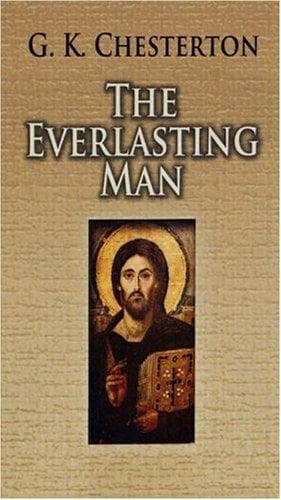
The Everlasting ManChesterton, G. K. (Gilbert Keith)
Religion
The Everlasting Man
Chesterton, G. K. (Gilbert Keith)
Catholic Church -- Apologetic works; Christianity and other religions; Religion
I have dwelt at some little length on this imaginative sort of paganism,
which has crowded the world with temples and is everywhere the parent of
popular festivity. For the central history of civilisation, as I see it,
consists of two further stages before the final stage of Christendom.
The first was the struggle between this paganism and something less
worthy than itself, and the second the process by which it grew in
itself less worthy. In this very varied and often very vague polytheism
there was a weakness of original sin. Pagan gods were depicted as
tossing men like dice; and indeed they are loaded dice. About sex
especially men are born unbalanced; we might almost say men are born
mad. They scarcely reach sanity till they reach sanctity. This
disproportion dragged down the winged fancies; and filled the end of
paganism with a mere filth and litter of spawning gods. But the first
point to realise is that this sort of paganism had an early collision
with another sort of paganism; and that the issue of that essentially
spiritual struggle really determined the history of the world. In order
to understand it we must pass to a review of the other kind of paganism.
It can be considered much more briefly; indeed, there is a very real
sense in which the less that is said about it the better. If we have
called the first sort of mythology the day-dream, we might very well
call the second sort of mythology the nightmare.
Superstition recurs in all ages, and especially in rationalistic ages. I
remember defending the religious tradition against a whole
luncheon-table of distinguished agnostics; and before the end of our
conversation every one of them had procured from his pocket, or
exhibited on his watch-chain, some charm or talisman from which he
admitted that he was never separated. I was the only person present who
had neglected to provide himself with a fetish. Superstition recurs in a
rationalist age because it rests on something which, if not identical
with rationalism, is not unconnected with scepticism. It is at least
very closely connected with agnosticism. It rests on something that is
really a very human and intelligible sentiment, like the local
invocations of the _numen_ in popular paganism. But it is an agnostic
sentiment, for it rests on two feelings: first that we do not really
know the laws of the universe; and second that they may be very
different from all that we call reason. Such men realise the real truth
that enormous things do often turn upon tiny things. When a whisper
comes, from tradition or what not, that one particular tiny thing is the
key or clue, something deep and not altogether senseless in human nature
tells them that it is not unlikely. This feeling exists in both the
forms of paganism here under consideration. But when we come to the
second form of it, we find it transformed and filled with another and
more terrible spirit.
Public-domain text, read in full here on John Shaqi.
Reviews
Reviews
No reviews yet
Be the first to share your thoughts on this work.
Elsewhere in the archive
Join the Discussion
Join the discussion
Sign in to leave a comment or review.
Sign InorCreate an account