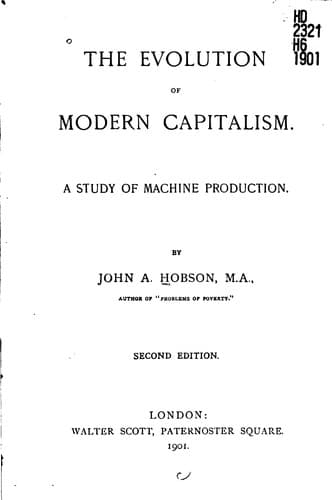
The Evolution of Modern Capitalism: A Study of Machine ProductionHobson, J. A. (John Atkinson)
History
The Evolution of Modern Capitalism: A Study of Machine Production
Hobson, J. A. (John Atkinson)
Capitalism; Industries -- History; Machinery in the workplace
Effective competition in retail trade sometimes requires
concentration, sometimes dispersion of business. But the most
characteristic modern movement in retail trade is a combination of the
centralising and dispersive tendencies, and is related to the
enlargement of the business-unit which we found proceeding everywhere
in industry. The large distributing company with a number of local
branch agents, who call regularly at the house of the consumer for
orders, is the most highly organised form of retail trade. In all the
departments of regular and general consumption the movement is towards
this constant house-to-house supply. The wealthier classes in towns
have already learned to purchase all the more perishable forms of food
and many other articles of house consumption in this way, while the
growing facilities of postage and conveyance of goods enable them to
purchase from a large central store by means of a price-list all other
consumables into which the element of individual taste or caprice
does not largely enter. This habit is spreading in the smaller towns
among the middle classes, so that the small dispersed retail
businesses are becoming more and more dependent upon the supply of the
needs of the working classes, and of such articles of comfort and
luxury as may appeal to the less regular and calculable tastes of the
moneyed classes. Just as in towns we have a constant automatic supply
of water and gas instead of an intermittent supply dependent on a
number of individual acts of purchase, so it seems likely that all the
routine wants of the consumer will be supplied.
How far mechanical inventions may be applied to increase the facility
and cheapen the cost of this distribution it is difficult to say. The
automatic machine for distributing matches and sweetmeats is adaptable
to most forms of routine consumption. In the larger stores many kinds
of labour-saving machinery are already applied. As steam or electric
power is adopted more widely in the local transport services the
retail distribution of goods from a large single centre is likely to
proceed apace, and a displacement of human labour by machinery similar
to that which is taking place in manufacture will take place in
distribution. So far as the wants of large classes of the public
become regular and their consumption measurable in quantity, machinery
will unquestionably take over the labour of distribution, especially
in the large towns which are absorbing in a way convenient for
mechanical distribution a larger proportion of the consuming public.
With each new encroachment of machinery into the domain of the
distributing trades the characteristics of machine-industry, enlarged
mass of the business, increased area of the market, increased
complexity of relations to other trades, increased specialisation of
local activity will be clearly discernible.
Public-domain text, read in full here on John Shaqi.
Reviews
Reviews
No reviews yet
Be the first to share your thoughts on this work.
Elsewhere in the archive
Join the Discussion
Join the discussion
Sign in to leave a comment or review.
Sign InorCreate an account