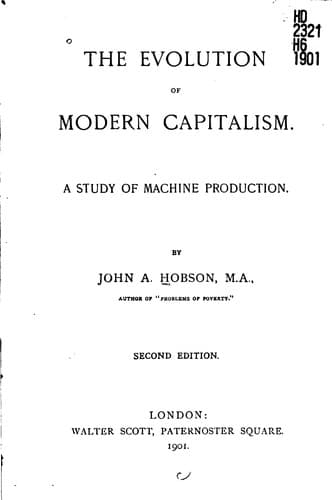
The Evolution of Modern Capitalism: A Study of Machine ProductionHobson, J. A. (John Atkinson)
History
The Evolution of Modern Capitalism: A Study of Machine Production
Hobson, J. A. (John Atkinson)
Capitalism; Industries -- History; Machinery in the workplace
§ 13. The specialisation of certain districts within the town, though
far less rigid than in the mediæval town, is very noticeable in the
larger centres of industry. Natural causes often determine this
division of localities, as in the case of the riverside industries,
brick-making and market-gardening in the outer suburbs. Round the
central station in every large town, for convenience of work and life,
settle a number of industries related to the carrying trade. Every
trade, market, or exchange is a centre of attraction. So the broking,
banking, and the general financing businesses are grouped closely
round the Royal Exchange. Mark Lane and Mincing Lane are centres of
the corn and tea trades. In all town industries not directly engaged
in retail distribution there are certain obvious economies and
conveniences in this gregariousness. Agents, travellers, collectors,
and others who have relations of sale or purchase with a number of
businesses in a trade find a number of disadvantages in dealing with a
firm locally detached from the main body, so that when a district is
once recognised as a trade centre, it becomes increasingly important
to each new competitor to settle there. The larger the city the
stronger this force of trade centralisation. Hence in London,
untrammelled by guild or city regulations, we find a strong
localisation of most wholesale and some retail businesses. In retail
trade, however, the economic gain is less universal. Since retail
commodities are chiefly for use in the home, and homes are widely
distributed, the convenience of being near one's customers and away
from trade competitors is often a predominating motive. Shops which
sell bread, meat, fish, fruit, groceries, articles which are bought
frequently and mostly in small quantities, shops selling cheaper
articles of ordinary consumption, such as tobacco, millinery,
stationery, and generally shops selling articles for domestic use, the
purchase of which falls to women, are widely dispersed. On the other
hand, where the articles are of a rarer and more expensive order, when
it is likely that the purchaser will seek to compare price and
character of wares, and will presumably be willing to make a special
journey for the purpose, the centralising tendency prevails in retail
trade. So we find the vendors of carriages, pianos, bicycles, the
heavier articles of furniture, jewellery, second-hand books, furs, and
the more expensive tailors and milliners clustering together in a
special street or neighbourhood.
Public-domain text, read in full here on John Shaqi.
Reviews
Reviews
No reviews yet
Be the first to share your thoughts on this work.
Elsewhere in the archive
Join the Discussion
Join the discussion
Sign in to leave a comment or review.
Sign InorCreate an account