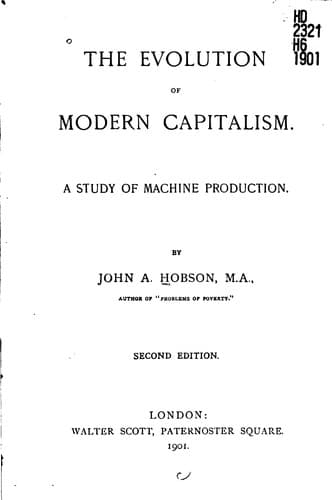
The Evolution of Modern Capitalism: A Study of Machine ProductionHobson, J. A. (John Atkinson)
History
The Evolution of Modern Capitalism: A Study of Machine Production
Hobson, J. A. (John Atkinson)
Capitalism; Industries -- History; Machinery in the workplace
[118] Foreign competition with English textiles, though comparatively
modern so far as the more highly developed machine-made fabrics is
concerned, was keenly felt early in the century in hand-made goods.
Schulze-Gaevernitz points out that the depression in work and wages of
the hand-loom workers in 1820 was due more to foreign competition than
to the new machinery. (_Der Grossbetrieb_, p. 41.)
[119] Yeats, _The Golden Gates of Trade_, p. 12. (Philip & Son.)
[120] Cf. Schulze-Gaevernitz's minute investigation of this whole
subject, _Der Grossbetrieb_, pp. 98, 99, etc.
[121] Schulze-Gaevernitz, p. 110.
[122] For the gain of female over male employment in textile
factories, cf. Chap. xi.
[123] In a free application of Spencer's formula of evolution to
modern industry I have not included the quality of "definiteness,"
which close reflection shows to possess no property which is not
included under heterogeneity and cohesiveness.
CHAPTER V.
THE FORMATION OF MONOPOLIES IN CAPITAL.
§ 1. _Productive Economies of the Large Business._
§ 2. _Competitive Economies of the Large Business._
§ 3. _Intenser Competition of the few Large Businesses._
§ 4. _Restraint of Competition and Limited Monopoly._
§ 5. _Facilities for maintaining Price-Lists in different
Industries._
§ 6. _Logical Outcome of Large-Scale Competition._
§ 7. _Different Species of "Combines."_
§ 8. _Legal and Economic Nature of the "Trust."_
§ 9. _Origin and "Modus Operandi" of the Standard Oil Trust._
§ 10. _The Economic Strength of other Trusts._
§ 11. _Industrial Conditions favourable to "Monopoly."_
§ 1. The forces which are operating to drive capital to group itself
in larger and larger masses, and the consequent growth of the
business-unit, require special study in relation to changes effected
in the character of competition in the market and the establishment of
monopolies. The economies which give to the large business an
advantage over the small business may be divided into two
classes--economies of productive power, and economies of competitive
power.
In the first class will be placed those economies which arise from
increased sub-division of labour and increased efficiency of
productive energy, and which represent a net saving in the output of
human energy in the production of a given quantity of commodities,
from the standpoint of the whole productive community. These include--
(_a_) The effort saved in the purchase and transport of raw materials
in large quantities as compared with small quantities, and a
corresponding saving in the sale and transport of the goods,
manufactured or other. Under this head would come the discovery and
opening up of new markets for purchase of raw materials and sale of
finished goods, and everything which increases the area of effective
competition and co-operation in industry.
Public-domain text, read in full here on John Shaqi.
Reviews
Reviews
No reviews yet
Be the first to share your thoughts on this work.
Elsewhere in the archive
Join the Discussion
Join the discussion
Sign in to leave a comment or review.
Sign InorCreate an account