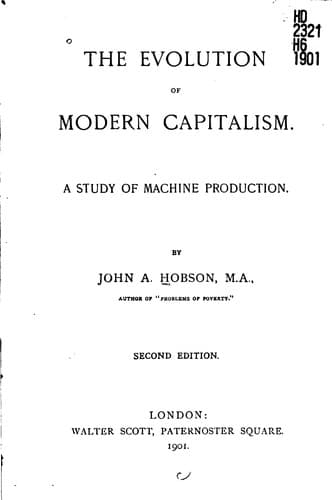
The Evolution of Modern Capitalism: A Study of Machine ProductionHobson, J. A. (John Atkinson)
History
The Evolution of Modern Capitalism: A Study of Machine Production
Hobson, J. A. (John Atkinson)
Capitalism; Industries -- History; Machinery in the workplace
(_b_) The adoption of the best modern machinery. Much expensive
machinery will only "save labour" when it is used to assist in
producing a large output which can find a tolerably steady market. The
number of known or discoverable inventions for saving labour which are
waiting either for an increase in the scale of production or for a
rise in the wages of the labour they might supersede, in order to
become economically available, may be considered infinite. With every
rise in the scale of production some of these pass from the "unpaying"
into the "paying" class, and represent a net productive gain in saved
labour of the community.
(_c_) The performance of minor or subsidiary processes upon the same
premisses or in close organic connection with the main process, the
establishment of a special workshop for repairs, various economies in
storage, which attend large-scale production.
(_d_) Economies consisting in saved labour and increased efficiency of
management, superintendence, clerical and other non-manual work, which
follow each increase of size in a normally constructed business. These
are often closely related to (_b_), as where clerical work is
economised by the introduction of type-writers or telephonic
communication, and to (_c_), as by the establishment of more numerous
and convenient centres of distribution.
(_e_) The utilisation of waste-products, one of the most important
practical economies in large-scale production.
(_f_) The capacity to make trial of new experiments in machinery and
in industrial organisation.
§ 2. To the class Economies in Competitive Power belong those
advantages which a large business enjoys in competing with smaller
businesses, which enable it either to take trade away from the latter,
or to obtain a higher rate of profits without in any way increasing
the net productiveness of the community. This includes--
(1) A large portion of the economy in advertising, travelling, local
agents, and the superiority of display and touting which a large
business is able to afford. In most cases by far the greater part of
this publicity and self-recommendation is no economy from the
standpoint of the trade or the community, but simply represents a gain
to one firm compensated by a loss to others. In not a few cases the
"trade" may be advantaged to the damage of other trades or of the
consumer, as when a class of useless or deleterious drugs is forced
into consumption by persistent methods of self-appraisal which deceive
the public.
Public-domain text, read in full here on John Shaqi.
Reviews
Reviews
No reviews yet
Be the first to share your thoughts on this work.
Elsewhere in the archive
Join the Discussion
Join the discussion
Sign in to leave a comment or review.
Sign InorCreate an account