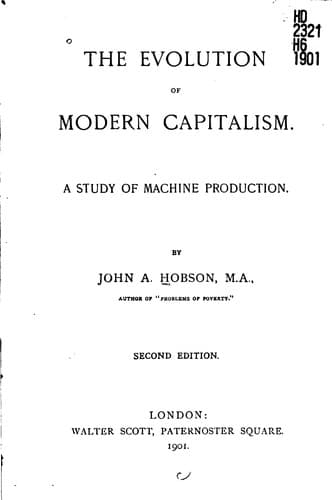
The Evolution of Modern Capitalism: A Study of Machine ProductionHobson, J. A. (John Atkinson)
History
The Evolution of Modern Capitalism: A Study of Machine Production
Hobson, J. A. (John Atkinson)
Capitalism; Industries -- History; Machinery in the workplace
(2) The power of a large business to secure and maintain the sole use
of some patent or trade secret in machinery or method of manufacture
which would otherwise have gone to another firm, or would have become
public property in the trade, represents no public economy, and
sometimes a public loss. Where such improvement is due solely to the
skill and enterprise of a business man, and would not have passed into
use unless the sole right were secured to his business, this economy
belongs to the productive class.
(3) The superior ability of a large business to depress wages by the
possession of a total or partial monopoly of local employment, the
corresponding power to obtain raw material at low prices, or to extort
higher prices from consumers than would obtain under the pressure of
free competition, represent individual business economies which may
enable a large business to obtain higher profits.
§ 3. Now all these forces operative in trades which are said to be
subject to the law of increasing returns tend to increase the size and
to diminish the number of businesses competing within a given area. In
some industries the expanding size of the market or area of
competition keeps pace with this movement, so that the total number of
the larger competitors within the market may be as great as before.
But in most of the markets the growing scale of the business is
attended by an absolute diminution in the number of effective
competitors, or at any rate by an increase which is very much smaller
than the increase in the amount of trade that is done.
So long as we have merely the substitution of a smaller number of
large competing businesses for a larger number of small ones, no
radical change is effected in the nature of industry. So long as
every purchaser is able to buy from two or more equally developed and
effectively competing firms he can make them bid against one another
until he obtains the full advantage of the economies of large-scale
production which are common to them. So long as there remains
effective competition, all the productive economies pass into the
hands of the consumer in reduction of price. Nay, more than this, a
competing firm cannot keep to itself the advantages of a private
individual economy if its competitor has another private economy of
equal importance. If A and B are two closely competing firms, A owning
a special machine capable of earning for him 2 per cent. above the
normal trade profit, and B owning a similar advantage by possession of
"cheaper labour," these private economies will be cancelled by
competition, and pass into the pocket of the consuming public.
Public-domain text, read in full here on John Shaqi.
Reviews
Reviews
No reviews yet
Be the first to share your thoughts on this work.
Elsewhere in the archive
Join the Discussion
Join the discussion
Sign in to leave a comment or review.
Sign InorCreate an account