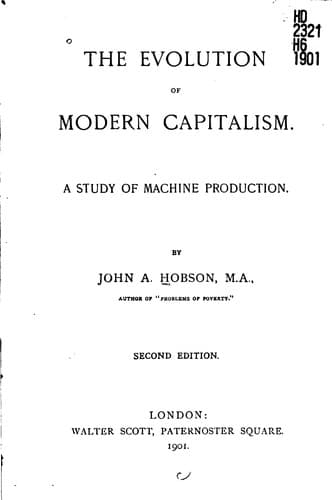
The Evolution of Modern Capitalism: A Study of Machine ProductionHobson, J. A. (John Atkinson)
History
The Evolution of Modern Capitalism: A Study of Machine Production
Hobson, J. A. (John Atkinson)
Capitalism; Industries -- History; Machinery in the workplace
§ 7. The motive which induces a number of businesses hitherto
separate, or associated merely for certain specific actions, such as
the fixing of prices or wages, to amalgamate so that they form a
single capital on which a single rate of interest is paid, is a
double-edged one. There is, on the one hand, the desire to protect
themselves against excessive competition and cutting of rates, and on
the other hand a desire to secure the advantages which arise from
monopoly. The way in which Syndicates and Trusts are regarded depends
very much from which of these two aspects they are regarded. Those who
consider these business "combines" as arbitrary and high-handed
interferences with freedom of commerce, undertaken in order to place
in the hands of a few persons a power to rob and oppress the consuming
public by legalised extortion, regard the motive of combination to be
monopoly. On the other hand, the combining firms represent themselves
as the victims of circumstances, bound in self-protection to combine.
Our analysis of the operations of commercial competition enables us to
see that these two forces are not really separate, but are only two
ways of looking at the same action. Every avoidance of so-called
"excessive" competition is _ipso facto_ an establishment of a
monopoly. The tariff of prices established a weak and partial
monopoly. The "combine," whether it takes the name of "ring,"
"syndicate," or "trust," succeeds, in so far as it establishes a
stronger and more absolute monopoly.
In their economic aspect these terms are somewhat vague, the vagueness
arising in some degree from the changing and secret shapes these
combinations often find it convenient to adopt in order to preserve
the appearance of competition, or to avoid public obloquy or legal
interference. "Combine" is probably the generic term which covers all
these operations. A syndicate of capitalists are said to form a
"combine" with the view of controlling prices so as to pay a
profitable interest. If they apply their capital not to the
acquisition of the plant and machinery of manufacture with the view of
regulating production, but directly and mainly to the planning of some
speculative stroke or series of strokes in the produce market,
obtaining temporary control of sufficient goods of a particular kind
to enable them to manipulate prices, they are said to form a "corner"
or "ring." Such forms of combined action are generally of short
duration. Technically they consist in an artificial diversion[125] of
a particular class of goods from the ordinary channel of a number of
competing owners into a single ownership, so that they may be held and
placed upon the supply market at such times and in such ways as to
enable the owner to obtain a famine price. The following description
of a wheat "corner" will serve to exemplify this method of
"combine":--
Public-domain text, read in full here on John Shaqi.
Reviews
Reviews
No reviews yet
Be the first to share your thoughts on this work.
Elsewhere in the archive
Join the Discussion
Join the discussion
Sign in to leave a comment or review.
Sign InorCreate an account