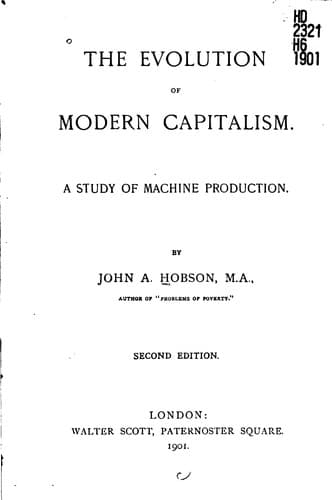
The Evolution of Modern Capitalism: A Study of Machine ProductionHobson, J. A. (John Atkinson)
History
The Evolution of Modern Capitalism: A Study of Machine Production
Hobson, J. A. (John Atkinson)
Capitalism; Industries -- History; Machinery in the workplace
"The man who forms a corner in wheat, first purchases or secures the
control of the whole available supply of wheat, or as near the whole
supply as he can. In addition to this he purchases more than is really
within reach of the market by buying 'futures,' or making contracts
with others who agree to deliver him wheat at some future time. Of
course he aims to secure the greater part of his wheat quietly, at low
figures; but after he deems that the whole supply is nearly in his
control, he spreads the news that there is a 'corner' in the market,
and buys openly all the wheat he can, offering higher and higher
prices, until he raises the price sufficiently high to suit him. Now
the men who have contracted to deliver wheat to him at this date are
at his mercy. They must buy their wheat of him at whatever price he
chooses to ask, and deliver it as soon as purchased, in order to
fulfil their contracts. Meanwhile mills must be kept in operation, and
the millers have to pay an increased price for wheat; they charge the
bakers higher prices for flour, and the bakers raise the price of
bread. Thus is told by the hungry mouths in the poor man's home the
last act in the tragedy of the corner."[126]
These "corners," of which in various forms and degrees the speculative
business on the stock and produce markets largely consists, are
attempts to substitute for a time a high monopoly price for a
competitive price by "rigging the market." Since the calculations upon
which these "corners" are based are essentially hazardous, attempted
corners frequently break down. One of the most special examples of the
collapse of a powerful corner in recent years is that of "La Société
Industrielle Commerciale des Métaux," commonly known as the "Copper
Syndicate." A body of French capitalists, for the most part not owners
of mines or metal merchandise, but speculators pure and simple, placed
a sum of money with the intention of cornering the supply of "tin."
Before completing this design they were induced to undertake a larger
speculation in the "copper market." In 1887 they entered into
contracts with the largest copper-producing companies in various
countries, agreeing to buy all the copper produced for the next three
years at a fixed price of 13 cents per pound, with an added bonus
equivalent to half the profit from their sale of the same. In 1888 the
Syndicate sought to extend its contracts with chief mining companies
to cover a period of twelve years, arranging with them also to limit
the output of copper. For some time they held the market in their
grip, and prices advanced considerably. But partly owing to a failure
to complete their contracts securing a restriction in production, and
partly from inability to meet their current liabilities, the "corner"
was broken down in 1889, and the artificially inflated prices fell.
Not only are the makers of "corners" liable to these miscalculations,
but they are liable to be overthrown by counter combinations of
Public-domain text, read in full here on John Shaqi.
Reviews
Reviews
No reviews yet
Be the first to share your thoughts on this work.
Elsewhere in the archive
Join the Discussion
Join the discussion
Sign in to leave a comment or review.
Sign InorCreate an account