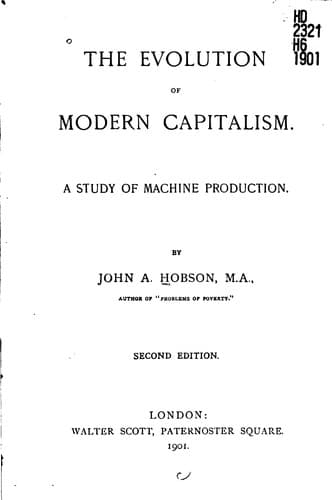
The Evolution of Modern Capitalism: A Study of Machine ProductionHobson, J. A. (John Atkinson)
History
The Evolution of Modern Capitalism: A Study of Machine Production
Hobson, J. A. (John Atkinson)
Capitalism; Industries -- History; Machinery in the workplace
(1) In surrendering the power to manage and control their business to
some persons other than those legally authorised.
(2) In engaging, through the Trust, in kinds of business not
authorised by the charter.
§ 9. It is, however, the economic character and powers of the Trust,
and not its legal position, which concern us here.
The following short history of the origin and _modus operandi_ of the
Standard Oil Trust, the largest and in some respects the strongest of
these organisations, will serve to give distinctiveness to the idea of
the Trust:--
Petroleum began to be an article of extensive commerce about the year
1862. The wells from which the crude petroleum oil was drawn were in
Pennsylvania, and the work of boring the wells with machinery and
extracting the oil grew to be a considerable business. The crude oil
was sold to various refiners, who set up factories in Cleveland
(Ohio), in Pittsburg, and in several other cities. By 1865 these
factories had become pretty numerous, and in that year a private
refinery at Cleveland, owned by a few partners, obtained a charter
forming it into a corporation entitled the Standard Oil Company, with
a capital of $100,000. Until 1870 the progress of the company was
comparatively slow. In order to increase their hold upon the sources
of production in Pennsylvania, and to expand their trade, they began
to purchase stock in corporations already existing in that State, and
succeeded in establishing others, with which they worked in close
alliance. A Standard Oil Company was organised at Pittsburg, the stock
of which passed into the hands of the owners of the Cleveland Company.
They then proceeded to establish agencies in other States, primarily
for the sale of their goods, but when these businesses were firmly
planted they obtained for them from the several States charters
incorporating them as companies for refining oil. In 1872 the
shareholders of the Standard Oil Companies at Cleveland, Pittsburg,
and Philadelphia organised another corporation called the South
Improvement Company, obtaining a charter from the State of
Pennsylvania. This corporation, which was in fact though not in legal
form the "Standard Oil Companies," then entered into contracts with
the New York Central and Hudson River Railroad Company, the Erie
Railway Company, and several other lines which traversed the
oil-producing country, for the shipment of petroleum. The South
Improvement Company agreed to ship over these railways all the
petroleum products. In return the railway companies agreed to carry
their goods, not upon the terms open to other customers, but with a
system of rebates, paid not only upon the oil shipped by the company,
but upon that shipped by any other competing companies. "In one
locality the railroad companies were to charge oil shippers as freight
not exceeding $1.50 per barrel, and pay a rebate to the South
Improvement Company of $1.06 per barrel, whether it was the shipper of
Public-domain text, read in full here on John Shaqi.
Reviews
Reviews
No reviews yet
Be the first to share your thoughts on this work.
Elsewhere in the archive
Join the Discussion
Join the discussion
Sign in to leave a comment or review.
Sign InorCreate an account