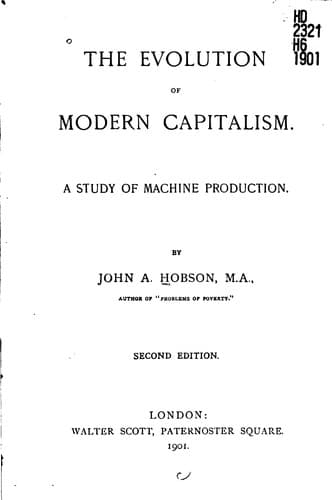
The Evolution of Modern Capitalism: A Study of Machine ProductionHobson, J. A. (John Atkinson)
History
The Evolution of Modern Capitalism: A Study of Machine Production
Hobson, J. A. (John Atkinson)
Capitalism; Industries -- History; Machinery in the workplace
the oil or not, so that under these contracts the Standard Oil Company
members would pay no more than 44 cents per barrel as freight to the
carrier, while their competitors would pay $1.50, and of this last sum
the railways were to pay back to the combination $1.06 per
barrel."[131]
Though this monstrous conspiracy was quickly unmasked, and the South
Improvement Company lost its charter, secret negotiations with the
railway companies enabled the Standard Oil Companies to strengthen
themselves by this system of rebates paid out of the pockets of their
business rivals. Chiefly by means of these and other discriminating
contracts they were enabled to enlarge their sphere of activity, and
making full use of their growing capital, succeeded in destroying or
absorbing their competitors, until, as early as 1875, they held a
practical monopoly of the refineries of the interior. No fewer than
seventy-four refineries are stated to have been bought up, leased, or
bankrupted by the Standard Oil Company in Pennsylvania alone in the
course of its career.
Until about 1878 the chief source of power of the company seems to
have been the alliance with the railroads and the local monopolies
obtained by buying up or crushing rival businesses. But the president,
Mr. Rockefeller, and his associates were men of keen business ability,
who understood how to make use of the inventive genius of the abler
employees who passed into their service, and of the improvements in
method of production and distribution of oil which were suggested. In
the next few years the company were enabled to effect enormous
economies in the storage and conveyance of oil. Pipe lines were laid
down connecting New York, Philadelphia, Baltimore, Buffalo, Pittsburg,
Cleveland, and Chicago, and a network of feeding lines joining the
sources of supply. Thousands of huge tanks were erected for holding
surplus stores; a large number of agencies were established along the
sea-shore with storage attached. Further considerable economies were
effected by the undertaking of the manufacture of barrels and cans and
other subsidiary articles required in the trade. At the close of 1881
the owners of the entire capital of fifteen corporations and parts of
the stock of a number of others, the latter chiefly trading companies,
established the Trust. The number of shareholders thus associated was
forty, and they placed their stocks in the hands of nine of their
number as trustees, who continued to administer the whole business,
paying interest upon the certificates which represented the stock of
the several shareholders until March 1892, when the Trust was legally
dissolved. The legal dissolution of the Trust has not, however,
materially impaired its economic unity and power; on the contrary, it
has extended in the United States its monopolic control of the
market, and has already established a strong control over several
European markets for the sale of oil, and over the chief natural
sources of supply.
Public-domain text, read in full here on John Shaqi.
Reviews
Reviews
No reviews yet
Be the first to share your thoughts on this work.
Elsewhere in the archive
Join the Discussion
Join the discussion
Sign in to leave a comment or review.
Sign InorCreate an account