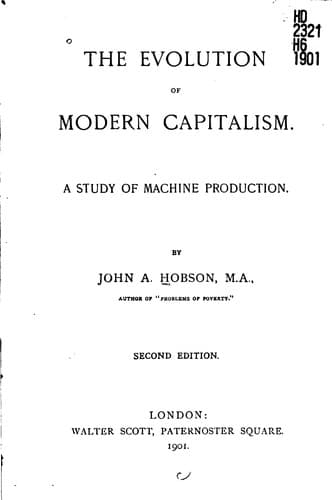
The Evolution of Modern Capitalism: A Study of Machine ProductionHobson, J. A. (John Atkinson)
History
The Evolution of Modern Capitalism: A Study of Machine Production
Hobson, J. A. (John Atkinson)
Capitalism; Industries -- History; Machinery in the workplace
This condition of ruinous competition must be recognised as the normal
condition of all highly-organised businesses where modern machinery is
applied, and which are not sheltered by some private economy in the
shape of special facilities in producing or in disposing of their
goods. Even the Standard Oil Company, as we saw, claimed that a policy
of consolidation was forced upon it by the conditions of the market.
But this claim is not a refutation, but an admission of the statement
that the object of a Trust is to obtain monopoly prices; for these
ruinously low prices and profits are the result of free competition,
and the only alternative to this free competition is monopoly. Hence
it is a legitimate conclusion that the economic object of a Trust is
to substitute monopoly for competitive prices, and to do this more
effectively than can be done by the mere acceptance of a common
price-list by the separate firms engaged in a branch of production. In
order to attain this object it is not necessary that the Trust shall
comprise all the capital engaged in an industry. Even when the
Standard Oil Trust was firmly established, and was, according to its
own admission, paying 12-1/2 or 13 per cent. on its highly-watered
stock, there appears to have existed no fewer than 111 smaller
independent companies competing with it directly or indirectly at some
point within the area of its market.[134] But the Standard Oil Trust
was able to control prices, as the producer of some 75 per cent. of
the total product, and the practical monopolist over the main area of
its market. Similarly the Sugar Refineries Trust in 1888 had a firm
grip over prices by its possession of 80 per cent. of the sugar
refining capacity of the Atlantic Coast, or 65 per cent. of the sugar
consumed in the United States.[135] There are other cases where a
formally constructed Trust is for a time engaged in close effective
competition, either with another Trust, as was the position of the
Standard Oil Trust over a portion of its markets in the period 1881 to
1884, or with powerful companies not organised as Trusts. This is what
Mr. Gunton appears to consider the normal condition of a Trust, one in
which competition takes place between a few large bodies of capital
instead of between many smaller bodies.[136] Certain Trusts have
certainly been compelled to struggle for the retention of their
monopoly power over the market. A notorious example is that of the
Sugar Trust, which, after a most successful start in 1888, found
itself in 1890 face to face with a new and formidable competitor in
the shape of the Claus Spreckles refineries of Philadelphia and San
Francisco, and was compelled to forego the high profits it had been
making and fight for its existence under terms of keenest competition.
Public-domain text, read in full here on John Shaqi.
Reviews
Reviews
No reviews yet
Be the first to share your thoughts on this work.
Elsewhere in the archive
Join the Discussion
Join the discussion
Sign in to leave a comment or review.
Sign InorCreate an account