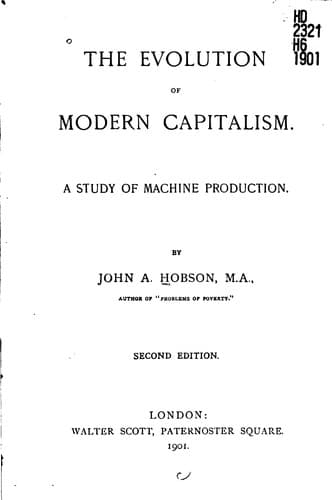
The Evolution of Modern Capitalism: A Study of Machine ProductionHobson, J. A. (John Atkinson)
History
The Evolution of Modern Capitalism: A Study of Machine Production
Hobson, J. A. (John Atkinson)
Capitalism; Industries -- History; Machinery in the workplace
But in so far as a Trust stands in this position it has failed to
achieve its industrial end of checking "ruinous competition" and the
"cutting of prices." It is not in the possession of the chief
economies of a Trust so long as it remains at warfare, for it is
compelled to expend all that it gains from the enlarged scale of
business and from the cessation of competition among its constituent
companies upon the strife with its single antagonist. A Trust in this
inchoate condition has no special economic character distinguishing it
from other large aggregates of competing capital. It is with
fully-formed trusts which are able to control prices and regulate to
some degree production and profits that we are concerned. An economic
Trust has its _raison d'être_ in monopoly. It may not have eliminated
all actual competitors, and is generally limited in its power by the
possibility of outside opposition, but so far as its power extends it
must be able to regulate prices upon non-competitive lines.
§ 11. A large number of different articles have at some stage in
their production fallen under the monopoly of a Trust.[137]
As is the case with "corners" and "rings" in the produce market,
certain classes of commodities lend themselves more readily than
others to the monopoly of Trusts.
There are three classes of industry which more easily than others
permit the formation of effective trusts.
(1) Industries connected with, or closely dependent on, the nature and
properties of land. When the whole or a large proportion of the raw
material required for producing any class of goods is confined within
a restricted area, the possession of that land by a single body of
owners will give a strong monopoly. It was not essential to the
Standard Oil Trust in its earlier years to own the sources of the oil
provided they could possess themselves of the stream after it had left
the source. But they have strengthened this monopoly lately by
securing the ownership of the oil lands in Pennsylvania. The most
striking example, however, is the monopoly of the anthracite coal
region in Pennsylvania by the shareholders of the Pennsylvania and
Reading Railway. The tendency of a Trust to strengthen its industrial
position and at the same time to find a profitable investment for its
surplus profits by fastening upon an earlier process of production or
a contiguous industry, and drawing it under the control of its
monopoly, is one of the most important evidences of the rapid growth
of the system in America. The rapidity with which the whole railway
system is passing into the hands of the two great monopolist
syndicates with the necessary result of stifling competition is in
some respects the most momentous economic movement in the United
States at the present time. The magnificent distances which separate
the great mass of the producers of agricultural and other raw products
from their market makes the railway their only high-road, and the fact
Public-domain text, read in full here on John Shaqi.
Reviews
Reviews
No reviews yet
Be the first to share your thoughts on this work.
Elsewhere in the archive
Join the Discussion
Join the discussion
Sign in to leave a comment or review.
Sign InorCreate an account