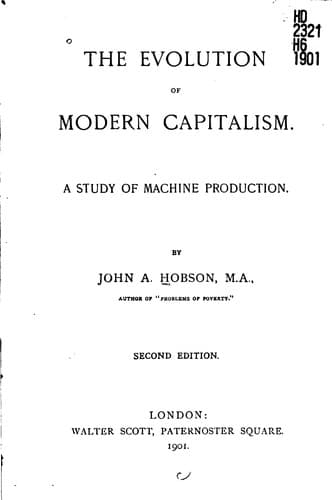
The Evolution of Modern Capitalism: A Study of Machine Production — John Shaqi
The Evolution of Modern Capitalism: A Study of Machine ProductionHobson, J. A. (John Atkinson)
History
The Evolution of Modern Capitalism: A Study of Machine Production
Hobson, J. A. (John Atkinson)
Capitalism; Industries -- History; Machinery in the workplace
§ 4. Since every industrial act in a modern community has its monetary
counterpart, and its importance is commonly estimated in terms of
money, it will be evident that the growth of capitalism might be
studied with great advantage in its monetary aspect. Corresponding to
the changes in productive methods under mechanical machinery we should
find the rapid growth of a complex monetary system reflecting in its
international and national character, in its elaborate structure of
credit, the leading characteristics which we find in modern productive
and distributive industry. The whole industrial movement might be
regarded from the financial or monetary point of view. But though such
a study would be capable of throwing a flood of light upon the
movements of concrete industrial factors at many points, the
intellectual difficulties involved in simultaneously following the
double study, in constantly passing from the more concrete to the more
abstract contemplation of industrial phenomena, would tax the mental
agility of students too severely, and would greatly diminish the
chance of a substantially accurate understanding of either aspect of
modern industry. We shall therefore in this study confine our
attention to the concrete aspect of capitalism, merely indicating by
passing references some of the direct effects upon industrial methods,
especially in the expansion and complexity of markets, of the
elaborate monetary system of modern exchange.
§ 5. The inherent difficulty which besets every literary presentation
of the study of a living and changing organism is here present in no
ordinary degree. A book of physiology is necessarily defective in that
it can neither present the just simultaneity of phenomena which occur
together, nor the just sequence of phenomena which are successive.
Diagrams may serve effectively to set forth tolerably simple
simultaneity, but a complex diagram inevitably fails of its object;
for it confuses the sight of one who seeks to simultaneously grasp the
whole, and thus compels a successive examination of different parts
which is generally inferior to skilled narration, in that it affords
no security of the fittest order of examination of the parts. For
certain simple relations between the movements of a few definite
objects a working model may be serviceable; but when complex changes
of shape, pace, and local relations exist, when intricate interaction
takes place, and when new phenomena arise affecting by their presence
all former ones, little can be effected by such visual presentment.
Still less can a succession of diagrams assist us to realise the
continuity of the working of such shifting forces as are presented in
industrial movements.
Public-domain text, read in full here on John Shaqi.
Reviews
Reviews
No reviews yet
Be the first to share your thoughts on this work.
Join the Discussion
Join the discussion
Sign in to leave a comment or review.
Sign InorCreate an account