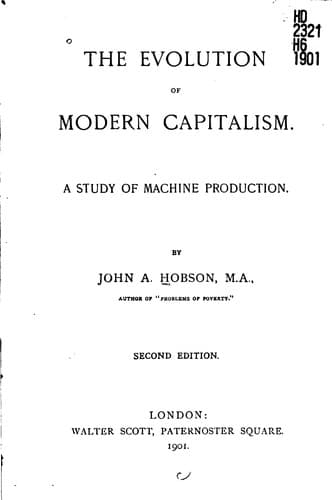
The Evolution of Modern Capitalism: A Study of Machine ProductionHobson, J. A. (John Atkinson)
History
The Evolution of Modern Capitalism: A Study of Machine Production
Hobson, J. A. (John Atkinson)
Capitalism; Industries -- History; Machinery in the workplace
§ 1. It remains to investigate the actual economic power which a
"monopoly" possesses over the several departments of an industrial
society. Although the "trust" may be taken as the representative form
of monopoly of capital, the economic powers it possesses are common in
different degrees to all the other weaker or more temporary forms of
combination, and to the private business which, by the possession of
some patent, trade secret, or other economic advantage, is in control
of a market. These powers of monopoly may be placed under four heads
in relation to the classes upon whose interests they operate--(_a_)
business firms engaged in an earlier or later process of production;
(_b_) actual and potential competitors or business rivals; (_c_)
employees of the Trust or other monopoly; (_d_) the consuming public.
(_a_) The power possessed by a monopoly placed in the transport stage,
or in one of the manufacturing or merchant stages, to "squeeze" the
earlier or less organised producers, has been illustrated by the
treatment of farmers by the railways and by the Elevator Companies
and the Slaughtering Companies of the United States. The Standard Oil
Trust, as we saw, preferred, until quite recently, to leave the oil
lands and the machinery for extracting crude oil in the hands of
unattached individuals or companies, trusting to their position as the
largest purchasers of crude oil to enable them to dictate prices. The
fall in the price paid by the company for crude oil from 9.19 cents in
1870 to 2.30 in 1881, when the Trust was formed, and the maintenance
of an almost uniform lower level from 1881 to 1890, testifies to the
closeness of the grip in which the company held the oil producers; for
although improvements in the machinery for sinking wells and for
extracting oil took place during the period, these economies in
production do not at all suffice to explain the fall. Indeed, the
method of the company's transactions with the oil producers, as
described by their own solicitor in his defence of the Trust, is
convincing testimony of their control of the situation:--"When the
producer of oil puts down a well, he notifies the pipe line company (a
branch of the Trust), and immediately a pipe line is laid to connect
with his well. The oil is taken from the tank at the well, whenever
requested, into the large storage tanks of the company, and is held
for the owner as long as he desires it. A certificate is given for it,
which can be turned into cash at any time; and when sold it is
delivered to the purchaser at any station on the delivery lines."[138]
In similar fashion the Sugar Trust, before the competition of the
Spreckles refineries arose, controlled the market for raw sugar. Nor
was this power exercised alone over the producers of raw sugar. It
extended to dictating the price at which the wholesale grocers who
took from them the refined sugar should sell to their customers.[139]
This power of a monopoly is not merely extended to the control of
Public-domain text, read in full here on John Shaqi.
Reviews
Reviews
No reviews yet
Be the first to share your thoughts on this work.
Elsewhere in the archive
Join the Discussion
Join the discussion
Sign in to leave a comment or review.
Sign InorCreate an account