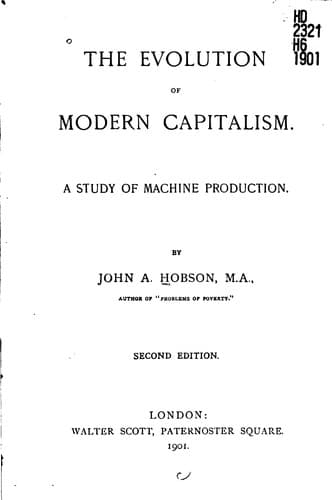
The Evolution of Modern Capitalism: A Study of Machine ProductionHobson, J. A. (John Atkinson)
History
The Evolution of Modern Capitalism: A Study of Machine Production
Hobson, J. A. (John Atkinson)
Capitalism; Industries -- History; Machinery in the workplace
prices in the earlier and later processes of production and
distribution of the commodity. One of the most potent forms it assumes
in manufactures where machinery is much used is a control over the
patentees and even the manufacturers of machinery. Where a strong
Trust exists, the patentee of a new invention can only sell to the
Trust and at the Trust's price. Charges are even made against the
Standard Oil Trust and other powerful monopolies to the effect that
they are in the habit of appropriating any new invention, whether
patented or not, without paying for it, trusting to their influence to
avoid the legal consequences of such conduct. There is indeed strong
reason to believe that the irresponsible position in which some of
these corporations are placed induces them to an unscrupulous use of
their great wealth for such purposes.
§ 2. (_b_) Since the prime object of a Trust is to effect sales at
profitable prices, and prices are directly determined by the
quantitative relation between supply and demand, it is clearly
advantageous for a Trust to obtain as full a power in the regulation
of the quantity of supply as is possible. In order to effect this
object the Trust will pursue a double policy. It will buy up such
rival businesses as it deems can be worked advantageously for the
purposes of the Trust. The price at which it will compel the owners of
such businesses to sell will have no precise relation to the value of
the business, but will depend upon the amount of trouble which such a
business can cause by refusing to come into the Trust. If the
outstanding firm is in a strong position the Trust can only compel it
to sell, by a prolonged process of cutting prices, which involves
considerable loss. For such a business a high price will be paid. By
this means a strongly-established Trust or Syndicate will bring under
its control the whole of the larger and better-equipped businesses
which would otherwise by their competition weaken the Trust's control
of the market. A smaller business, or an important rival who
persistently stands out of the Trust, is assailed by the various
weapons in the hands of the Trust, and is crushed by the brute force
of its stronger rival. The most common method of crushing a smaller
business is by driving down prices below the margin of profit, and by
the use of the superior staying power which belongs to a larger
capital starving out a competitor. This mode of exterminating warfare
is used not merely against actually existing rivals, as where a
railway company is known to bring down rates for traffic below cost
price in order to take the traffic of a rival line, but is equally
effective against the potential competition of outside capital. After
two or three attempts to compete with Jay Gould's telegraph line from
New York to Philadelphia had been frustrated by a lowering of rates to
a merely nominal price, the notoriety of this terrible weapon sufficed
to check further attempts at competition. In this way each
Public-domain text, read in full here on John Shaqi.
Reviews
Reviews
No reviews yet
Be the first to share your thoughts on this work.
Elsewhere in the archive
Join the Discussion
Join the discussion
Sign in to leave a comment or review.
Sign InorCreate an account