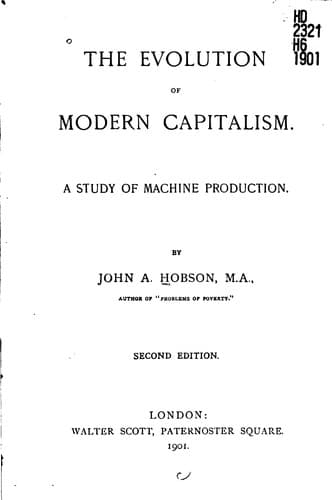
The Evolution of Modern Capitalism: A Study of Machine ProductionHobson, J. A. (John Atkinson)
History
The Evolution of Modern Capitalism: A Study of Machine Production
Hobson, J. A. (John Atkinson)
Capitalism; Industries -- History; Machinery in the workplace
It is even doubtful whether such bargains as that above described
between the Standard Oil Company and the Railways, whereby a
discriminative rate was maintained in favour of the Company, is
"unfair," though it was underhand and illegal. In the ordinary sense
of the term it was a "free" contract between the Railways and the Oil
Company, and in spite of its discriminative character might have been
publicly maintained had the law not interfered on a technical point.
The same is even true of the flagrant act of discrimination described
by Mr. Baker:--"A combination among manufacturers of railway
car-springs, which wished to ruin an independent competitor, not only
agreed with the American Steel Association that the independent
company should be charged $10 per ton more for steel than the members
of the combine, but raised a fund to be used as follows: when the
independent company made a bid on a contract for springs, one of the
members of the Trust was authorised to under-bid at a price which
would incur a loss, which was to be paid out of the fund. In this way
the competing company was to be driven out of business."[140] These
cases differ only in their complexity from the simpler modes of
underselling a business rival. Mean, underhand, and perhaps illegal
many of these tactics are, but after all they differ rather in degree
than in kind from the tactics commonly practised by most businesses
engaged in close commercial warfare. If they are "unfair," it is only
in the sense that all coercion of the weak by the strong is "unfair,"
a verdict which doubtless condemns from any moral standpoint the whole
of trade competition, so far as it is not confined to competing
excellence of production.
The only exercise of power by a Trust or Monopoly in its dealings with
competing capital which deserves to be placed in a separate category
of infamy, is the use of money to debauch the legislature into the
granting of protective tariffs, special charters or concessions, or
other privileges which enable a monopoly company to get the better of
their rivals, to secure contracts, to check outside competition, and
to tax the consuming public for the benefit of the trust-maker's
pocket. Under this head we may also reckon the tampering with the
administration of justice which is attributed, apparently not without
good reason, to certain of the Trusts, the use of the Trust's money to
purchase immunity from legal interference, or, in the last resort, to
buy a judgment in the Courts.
How far the more or less definite allegations upon this subject are
capable of substantiation it is beyond our scope to inquire, but
certain disclosures in connection with the Tweed Ring, the Standard
Oil Company, the Anthracite Coal Trust, and other syndicates induce
the belief that the more unscrupulous capitalists seek to influence
the Courts of Justice as well as the Houses of Legislature in the
pursuance of their business interests.
Public-domain text, read in full here on John Shaqi.
Reviews
Reviews
No reviews yet
Be the first to share your thoughts on this work.
Elsewhere in the archive
Join the Discussion
Join the discussion
Sign in to leave a comment or review.
Sign InorCreate an account