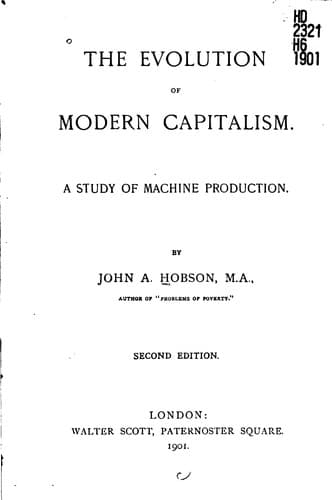
The Evolution of Modern Capitalism: A Study of Machine ProductionHobson, J. A. (John Atkinson)
History
The Evolution of Modern Capitalism: A Study of Machine Production
Hobson, J. A. (John Atkinson)
Capitalism; Industries -- History; Machinery in the workplace
and these restrictions are enforced upon their miners by holding cars
from them to fill, as upon competitors by withholding cars to go to
market. (Document No. 4, p. 77.)
Labour organisations are forbidden, and the men intentionally provoked
to strike to affect the coal market. The labouring population of the
local regions, finally, is kept "down" by special policemen, enrolled
under special laws, and often in violation of law, by the railroads
and coal and iron companies, practically when and in what number they
choose, and practically without responsibility to any one but their
employers, armed as the Corporation see fit with army revolvers or
Winchester rifles, or both; made detectives by statute, and not
required to wear their shields, provoking the public to riot (pp. 9
and 93-98), and then shooting them legally. "By the percentage of
wages," says the report of Congress, "by false measurements, by rents,
stores, and other methods the workman is virtually a chattel of the
operator."[144]
§ 4. (_d_) Those who admit that a Trust is in its essence a monopoly,
and that it is able, by virtue of its position, to sell commodities at
high prices, sometimes affirm that it is not to the interest of a
Trust to maintain high prices, and that in fact Trusts have generally
lowered prices. We have here a question of fact and a question of
theory. Of these the former presents the greater difficulty. It seems
a simple matter to compare prices before and after the formation of
the Trust, and to observe the tendencies to rise or fall. This
comparison has been made in a good many cases, with the result that
some Trusts seem to lower prices, others to raise them. The growth of
the Standard Oil Company and the strengthening of its power was
attended, as we saw, by a considerable fall of price. So also we are
told respecting the Cotton Seed Oil Trust, formed in 1883, that
"during these four years the price of cotton seed oil fell more than
eight times as much as it did during the five years before the Trust
was formed."[145] The rates of the most absolute monopoly, the Western
Union Telegraph Company, are very little higher than those which
prevail in England, where the Government works the telegraph system at
a considerable loss each year. The Sugar Trust, on the other hand,
directly it was formed, raised prices considerably. The same is true
of several of the other most conspicuous combinations.
Public-domain text, read in full here on John Shaqi.
Reviews
Reviews
No reviews yet
Be the first to share your thoughts on this work.
Elsewhere in the archive
Join the Discussion
Join the discussion
Sign in to leave a comment or review.
Sign InorCreate an account