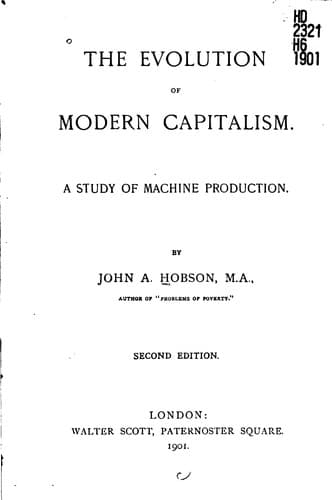
The Evolution of Modern Capitalism: A Study of Machine ProductionHobson, J. A. (John Atkinson)
History
The Evolution of Modern Capitalism: A Study of Machine Production
Hobson, J. A. (John Atkinson)
Capitalism; Industries -- History; Machinery in the workplace
the scope of industry, to change its _locale_, to abandon certain
branches and take up others, to substitute machinery for hand labour,
without any regard to the welfare of the employees who have been
associated with the fixed capital formerly in use. When to this we add
the reflection that the ability to choose its workmen out of an
artificially made over-supply of labour, rid of the competition of
other employers, gives the Trust a well-nigh absolute power to fix
wages, hours of work, to pay in truck, and generally to dictate terms
of employment and conditions of life, we understand the feeling of
distrust and antagonism with which the working classes regard the
growth of these great monopolies on both sides of the Atlantic.
The following is a short summary of the findings of a Committee of
Congress with reference to the relations existing between the railroad
and coal companies which control the anthracite coal-fields in
Pennsylvania and the coal-miners:--"Congress has found (Document No.
4) that the coal companies in the anthracite regions keep thousands of
surplus labourers in hand to underbid each other for employment and
for submission to all exactions; hold them purposely ignorant when the
mines are to be worked and when closed, so that they cannot seek
employment elsewhere; bind them as tenants by compulsion in the
companies' houses, so that the rent shall run against them whether
wages run or not, and under leases by which they can be turned out
with their wives and children on the mountain-side in mid-winter if
they strike; compel them to fill cars of larger capacity than agreed
upon; make them buy their powder and other working outfit of the
companies at an enormous advance on the cost; compel them to buy coal
of the company at the company's price, and in many cases to buy a
fixed quantity more than they need; compel them to employ the doctor
named by the company and to pay him whether sick or well; 'pluck' them
at the company's store, so that when pay-day comes round the company
owes the men nothing, there being authentic cases where 'sober,
hard-working miners toiled for years, or even a lifetime, without
having been able to draw a single dollar, or but few dollars in actual
cash,' in 'debt until the day they died;' refuse to fix the wages in
advance, but pay them upon some hocus-pocus sliding-scale, varying
with the selling price in New York, which the railway slides to suit
itself; and most extraordinary of all, refuse to let the miners know
the prices on which their living slides, a 'fraud,'" says the report
of Congress, "on its face" (pp. 71 and 72). The companies dock the
miners' output arbitrarily for slate and other impurities, and so can
take from their men 5 to 50 tons more in every 100 than they pay for
(p. 76). In order to keep the miners disciplined and the coal market
under supplied, the railroads restrict work, so that the miners often
have to live for a month on what they can earn in six or eight days,
Public-domain text, read in full here on John Shaqi.
Reviews
Reviews
No reviews yet
Be the first to share your thoughts on this work.
Elsewhere in the archive
Join the Discussion
Join the discussion
Sign in to leave a comment or review.
Sign InorCreate an account