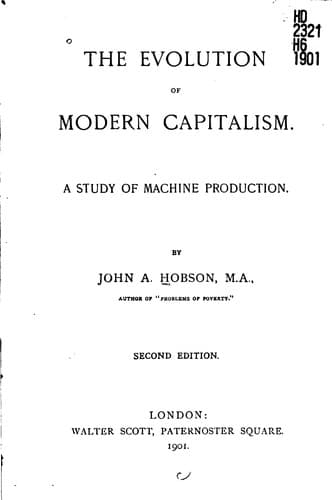
The Evolution of Modern Capitalism: A Study of Machine ProductionHobson, J. A. (John Atkinson)
History
The Evolution of Modern Capitalism: A Study of Machine Production
Hobson, J. A. (John Atkinson)
Capitalism; Industries -- History; Machinery in the workplace
A Trust, or other company, or a single individual who has a complete
monopoly of a class of goods for which there is a demand, will strive
to fix that price which shall give him the largest net profit on his
capital. The question with him will be simply this, "How many articles
shall I offer for sale?" If he offers only a small number the
competition of more urgent wants among the consumers will enable him
to sell the small number at a high price. Assuming, for the moment,
that the production of these articles was subject to the law of
constant returns--_i.e._, that a few things were produced relatively
as cheaply as many, this small sale would give the highest rate of
profit on each sale, for the "marginal utility" of the supply would be
high and would enable a high price to be obtained for the whole
supply. But if he possesses large facilities of production it may pay
him better to sell a larger number of articles at a lower price with a
lower rate of profit on each sale, because the aggregate of a larger
number of small profits may yield a larger net profit on his whole
capital. How far it will pay him to go on increasing the supply and
selling a larger number of articles at a lower price will entirely
depend upon the effect each increment of supply exercises upon demand,
and so upon prices and profits. Everything will hinge upon the
"elasticity of demand" in the particular case. If the object of the
monopoly satisfies a keen, widely-felt want, or stimulates a craving
for increased consumption among those who take off the earlier supply,
a large increase in supply may be attended by a comparatively small
fall in prices. Sometimes a large increase of supply at a lowered
price will, by reaching a new social stratum, or by forcing the
substitution of this article for another in consumption, so enlarge
the sale that though the margin of profit on each sale is small, the
net profit on the whole capital is very large. In all such cases of
great elasticity it may pay a monopolist to sell a large number of
articles at a low price.
Public-domain text, read in full here on John Shaqi.
Reviews
Reviews
No reviews yet
Be the first to share your thoughts on this work.
Elsewhere in the archive
Join the Discussion
Join the discussion
Sign in to leave a comment or review.
Sign InorCreate an account