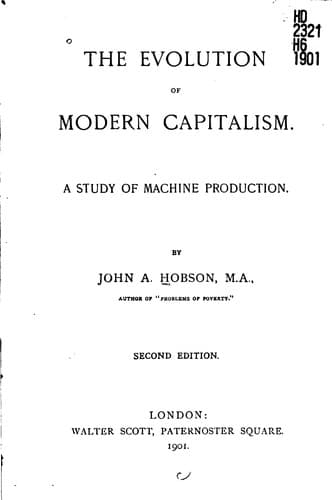
The Evolution of Modern Capitalism: A Study of Machine ProductionHobson, J. A. (John Atkinson)
History
The Evolution of Modern Capitalism: A Study of Machine Production
Hobson, J. A. (John Atkinson)
Capitalism; Industries -- History; Machinery in the workplace
Where the article belongs to that class in which the law of increasing
returns is strongly operative--_i.e._, where great economies in
expenses of production attend a larger scale of production, this
increase of supply and fall of prices may continue with no assignable
limit. On the other hand, where there is little elasticity of demand,
where an increase of supply can be taken off only at a considerable
fall of price, it will probably pay a monopolist to restrict
production and sell a small number of articles at a high price. It is
this motive which often induces the destruction of tons of fish and
fruit in the London markets for fear of spoiling the market. These
goods could be sold at a sufficiently low price, but it pays the
companies owning them to destroy them, and to sell a smaller number
which satisfies the wants of a limited class of people who "can afford
to pay." Now, when free competition exists among sellers, as among
buyers, this can never happen. It will always be to the interest of a
competing producer or dealer to lower his price below that which would
yield him the largest net profit on his capital were he a monopolist.
If he is a monopolist he will only lower his prices provided the
elasticity of demand in the commodity in question is so great that the
increased consumption will be so considerable as to yield him a larger
net profit. But if he is a competing dealer he does not look chiefly
to the consumption of the community, but to the proportion of that
consumption which he himself shall supply. The elasticity of demand,
so far as his individual business is concerned, is not limited to the
amount of the increased consumption of the community stimulated by a
lowering of prices, but includes that portion of the custom of his
rivals which he may be able to divert to himself. Hence it arises that
under free competition it will be the tendency of the several
competitors to drive down the prices to the point at which the most
advantageously placed competitors make the minimum profit on their
capital.
§ 5. It is all important to an understanding of the subject to
recognise that a monopoly price and a competitive price are determined
by the operation of an entirely different set of economic forces. The
loose opinion that it must be to the interest of a Trust or other
monopoly to sell at the same price as would be fixed by competition is
quite groundless.
Public-domain text, read in full here on John Shaqi.
Reviews
Reviews
No reviews yet
Be the first to share your thoughts on this work.
Elsewhere in the archive
Join the Discussion
Join the discussion
Sign in to leave a comment or review.
Sign InorCreate an account