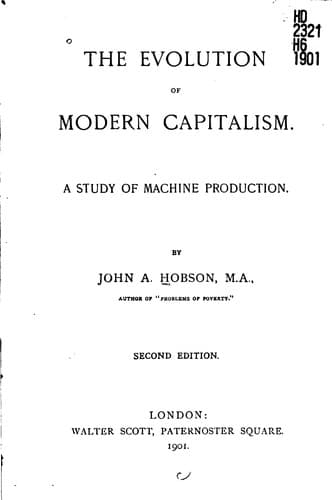
The Evolution of Modern Capitalism: A Study of Machine ProductionHobson, J. A. (John Atkinson)
History
The Evolution of Modern Capitalism: A Study of Machine Production
Hobson, J. A. (John Atkinson)
Capitalism; Industries -- History; Machinery in the workplace
In the illustration above we have assumed that a monopoly was starting
_de novo_. Where a Trust is formed, as is commonly the case, by an
amalgamation of existing capitals largely embodied in plant and
machinery of production, it will probably not pay to limit production
to a very small output, even though the largest proportionate margin
of profit might seem to stand there. For the interest upon the closed
mills and other idle capital should be reckoned among the expenses of
production for the purposes of determining the profitable price. Thus
where large means of production are owned by a monopoly it will seldom
pay to sell a very small supply at a very high price.
So far we have treated of absolute monopolies, eliminating all
consideration of competition. We have found that the supply and the
price of an article of absolute monopoly is determined by the relation
between expenses of production and flexibility of demand. Although a
new invention or a wide expansion of market may alter so considerably
the expenses of production of the several quantities of supply as to
materially affect monopoly-supply and prices, it is the latter
influence, that of flexibility of demand, that directly in each
specific case determines whether a Trust's prices shall be high or
low. When we find the Standard Oil Trust maintaining a low level of
prices, or the Western Union Telegraph Company charging low rates, we
shall find the explanation in the character of the public demand for
oil and telegraphic messages.
§ 7. A number of considerations relating to "demand" limit the
economic power of monopolies to charge high prices.
A monopoly price, as we have seen, exactly measures the marginal
utility of the supply, as indicated by the quantity of money which the
purchaser of the last increment of supply is just willing to pay for
it. When this marginal utility sinks fast with an increase of supply
the monopoly price will be high for it, and it will pay the monopolist
better to restrict the output and sell the limited supply at a high
price, because a large reduction of price will not stimulate a
proportionably large increase of consumption. So where the marginal
utility sinks slowly, it will pay to increase the supply and lower the
price, for each fall of price will stimulate a large increase of
consumption.
Since the marginal utility of a number of increments of supply will
not be the same in the case of any two commodities, it is evident that
the determination of monopoly prices is a very delicate operation.
It is not possible to present even an approximately accurate
classification of commodities in relation to the powers of a Trust or
Monopoly. But the following considerations will assist us to
understand why in some cases a Trust appears to raise prices, in
others to keep them as they were, and in others even to lower them:--
Public-domain text, read in full here on John Shaqi.
Reviews
Reviews
No reviews yet
Be the first to share your thoughts on this work.
Elsewhere in the archive
Join the Discussion
Join the discussion
Sign in to leave a comment or review.
Sign InorCreate an account