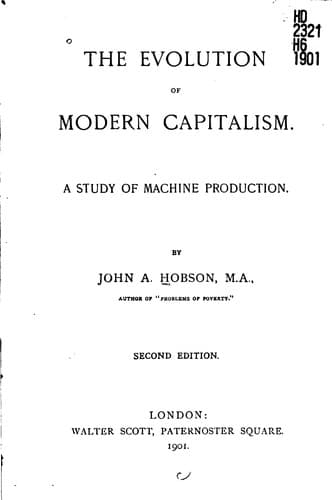
The Evolution of Modern Capitalism: A Study of Machine ProductionHobson, J. A. (John Atkinson)
History
The Evolution of Modern Capitalism: A Study of Machine Production
Hobson, J. A. (John Atkinson)
Capitalism; Industries -- History; Machinery in the workplace
(_a_) The urgency of the need which a commodity satisfies enables the
monopolist to charge high prices. Where a community is dependent for
life upon some single commodity, as the Chinese on rice, the
monopolist is able to obtain a high price for the whole of a supply
which does not exceed what is necessary to keep alive the whole
population. Thus a monopolist of corn or rice in a famine can get an
exorbitant price for a considerable supply. But after the supply is
large enough to enable every one to satisfy the most urgent need for
sustenance, the urgency of the need satisfied by any further supply
falls rapidly, for there is no comparison between the demand of famine
and the demand induced by the pleasures of eating.
A monopoly of a necessity of life is therefore more dangerous than any
other monopoly, because it not merely places the lives of the people
at the mercy of private traders, but because it will generally be the
interest of such monopolists to limit supply to the satisfaction of
the barest necessaries of life.
Next to a necessary in this respect will come what is termed a
"conventional necessary," something which by custom has been firmly
implanted as an integral portion of the standard of comfort. This
differs, of course, in different classes of a community. Boots may now
be regarded as a "conventional necessary" of almost all grades of
English society, and a monopolist could probably raise the price of
boots considerably without greatly diminishing the consumption. Half a
century ago, however, when boots were not firmly established as part
of the standard of comfort of the great mass of the working classes,
the power of a monopolist to raise prices would have been far smaller.
As we descend in the urgency of wants supplied we find that the
comforts and luxuries form a part of the standard of life of a smaller
and smaller number of persons, and satisfying intrinsically weaker
needs, are more liable to be affected by a rise of price.
Public-domain text, read in full here on John Shaqi.
Reviews
Reviews
No reviews yet
Be the first to share your thoughts on this work.
Elsewhere in the archive
Join the Discussion
Join the discussion
Sign in to leave a comment or review.
Sign InorCreate an account