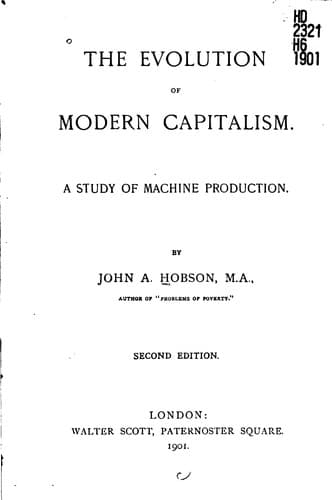
The Evolution of Modern Capitalism: A Study of Machine ProductionHobson, J. A. (John Atkinson)
History
The Evolution of Modern Capitalism: A Study of Machine Production
Hobson, J. A. (John Atkinson)
Capitalism; Industries -- History; Machinery in the workplace
(_b_) Closely related to this consideration, and working in with it at
every point, is the question of the possibility of substituting
another commodity for the one monopolised. This everywhere tempers the
urgency of the need attaching to a commodity. There are few, if any,
even among the commodities on which we habitually rely for food,
shelter, clothing, which we could not and would not dispense with if
prices rose very high. The incessant competition which is going on
between different commodities which claim to satisfy some particular
class of need cannot be got rid of by the monopoly of one of them.
This is probably the chief explanation of the low prices of the
Standard Oil. As an illuminant, oil is competing with gas, candles,
electricity, and unless the monopoly were extended laterally so as to
include these and any other possible illuminants, the Trust's prices
cannot be determined merely by the pressure of the need for artificial
light. Though to a modern society artificial light is probably even
more important than sugar, a Sugar Trust may have a stronger monopoly
and be able to raise prices higher than an Oil Trust, because the
substitutes for sugar, such as molasses and beetroot, are less
effective competitors than gas, candles, and electricity with oil.
The power of railway monopolies largely depends upon the degree in
which their services are indispensable, and no alternative mode of
transport is open. Sometimes, however, they miscalculate the extent of
their power. The high railway rates in England have recently led in
several quarters to a substitution of road and canal traffic in the
case of goods where rapidity of conveyance was not essential. So also
in other cases sea-transport has been substituted.
The stronger monopoly of American railways consists partly in the fact
that distances are so great, and the sea-board or other water
conveyance so remote, that over a large part of the Continent the
monopoly is untempered by alternative possibilities of transport.
Public-domain text, read in full here on John Shaqi.
Reviews
Reviews
No reviews yet
Be the first to share your thoughts on this work.
Elsewhere in the archive
Join the Discussion
Join the discussion
Sign in to leave a comment or review.
Sign InorCreate an account