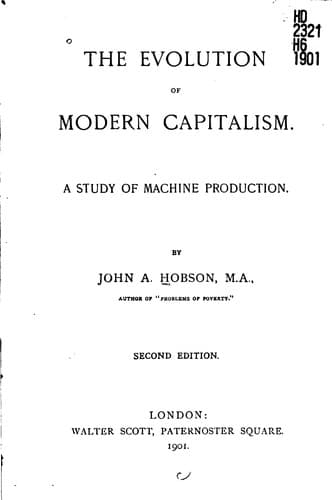
The Evolution of Modern Capitalism: A Study of Machine ProductionHobson, J. A. (John Atkinson)
History
The Evolution of Modern Capitalism: A Study of Machine Production
Hobson, J. A. (John Atkinson)
Capitalism; Industries -- History; Machinery in the workplace
The earlier inventions in the textile industries, and the general
application of steam to manufacture and to the transport services,
have played the most dramatic part in the industrial revolution of the
last hundred years. But it should be borne in mind that it is far from
being true that the great forces of invention have spent themselves,
and that we have come to an era of small increments in the growth of
productive power. On the contrary, within this last generation a
number of discoveries have taken place in almost all the chief
industrial arts, in the opening up of new supplies of raw material,
and in the improvement of industrial organisation, which have
registered enormous advances of productive power. In the United
States, where the advance has been most marked, it is estimated that
in the fifteen or twenty years preceding 1886 the gain of machinery,
as measured by "displacement of the muscular labour," amounts to more
than one-third, taking the aggregate of manufactures into account. In
many manufactures the introduction of steam-driven machinery and the
factory system belongs to this generation. The substitution of
machinery for hand labour in boot-making signifies a gain of 80 per
cent. for some classes of goods, 50 per cent. for others. In the silk
manufacture there has been a gain of 50 per cent., in furniture some
30 per cent., while in many minor processes, such as wood-planing, tin
cans, wall-papers, soap, patent leather, etc., the improvement of
mechanical productiveness per labourer is measured as a rise of from
50 to 300 per cent. or more. The gain is, however, by no means
confined to an extension of "power" into processes formerly performed
by human muscle and skill. Still more significant is the increased
mechanical efficiency in the foundational industries. In the
manufacture of agricultural implements the increase is put down at
from 50 to 70 per cent., in the manufacture of machines and machinery
from 25 to 40 per cent., while "in the production of metals and
metallic goods long-established firms testify that machinery has
decreased manual labour 33-1/3 per cent." The increase in the
productive power of cotton mills is far greater than this. From 1870
to 1884 the make of pig-iron rose 131 per cent. in Great Britain and
237 per cent. in the rest of the world.[151] "In building vessels an
approximate idea of the relative labour displacement is given as 4 or
5 to 1--that is, four or five times the amount of labour can be
performed to-day by the use of machinery in a given time that could be
done under old hand methods."[152]
Public-domain text, read in full here on John Shaqi.
Reviews
Reviews
No reviews yet
Be the first to share your thoughts on this work.
Elsewhere in the archive
Join the Discussion
Join the discussion
Sign in to leave a comment or review.
Sign InorCreate an account