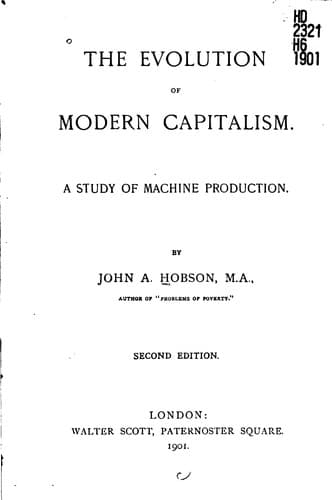
The Evolution of Modern Capitalism: A Study of Machine ProductionHobson, J. A. (John Atkinson)
History
The Evolution of Modern Capitalism: A Study of Machine Production
Hobson, J. A. (John Atkinson)
Capitalism; Industries -- History; Machinery in the workplace
In England the rise in productiveness of machinery is roughly
estimated at 40 per cent. in the period 1850 to 1885, and there is no
reason to suppose this is an excessive estimate. In the shipping
industry, where more exact statistics are available, the advance is
even greater. The diminution of manual labour required to do a given
quantity of work in 1884 as compared with 1870 is put down at no less
than 70 per cent., owing in large measure to the introduction and
increased application of steam-hoisting machines and grain elevators,
and the employment of steam power in steering, raising the sails and
anchors, pumping, and discharging cargoes.[153] In the construction of
ships enormous economies have taken place. A ship which in 1883 cost
£24,000 can now be built for £14,000. In the working of vessels the
economy of fuel, due to the introduction of compound-engines, has been
very large. A ton of wheat can now be hauled by sea at less than a
farthing per mile. Similarly with land haulage the economy of fuel has
made immense reductions in cost. "In an experiment lately made on the
London and North Western Railway, a compound locomotive dragged a ton
of goods for one mile by the combustion of two ounces of coal."[154]
The quickening of voyages by steam motor, and by the abandonment of
the old Cape route in favour of the Suez Canal, enormously facilitated
commerce. The last arrangement is calculated to have practically
destroyed a tonnage of two millions. The still greater facilitation of
intelligence by electricity did away with the vast system of
warehousing required by the conditions of former commerce. These
economies of the foundational transport industries have deeply
affected the whole commerce and manufacture of the country, and have
played no inconsiderable part in bringing about the general fall of
prices by lowering the expenses of production and stimulating an
increased output.
Excessive production of transport-machinery, especially of railways,
has played an important part as an immediate cause of modern trade
depression. The depression beginning in 1873 and culminating in 1878
is described as having its origin "in the excessive lock-up of capital
in the construction of railways, especially in America and Germany,
many of which, when built, had neither population to use them nor
traffic to carry; in the wild speculation that followed the German
assertion of supremacy on the Continent; in the exaggerated armaments,
which withdrew an inordinate amount of labour from productive
industry, and over-weighed the taxpayers of the great European
nations; and in over-production in the principal trades in all
European countries."[155]
Public-domain text, read in full here on John Shaqi.
Reviews
Reviews
No reviews yet
Be the first to share your thoughts on this work.
Elsewhere in the archive
Join the Discussion
Join the discussion
Sign in to leave a comment or review.
Sign InorCreate an account