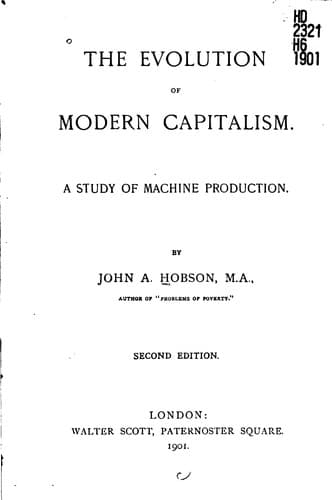
The Evolution of Modern Capitalism: A Study of Machine ProductionHobson, J. A. (John Atkinson)
History
The Evolution of Modern Capitalism: A Study of Machine Production
Hobson, J. A. (John Atkinson)
Capitalism; Industries -- History; Machinery in the workplace
§ 4. The direct causal connection between the increased productive
power of modern machinery and trade depression clearly emerges from a
comparison of the fluctuations in the several departments of industry
in different industrial countries. As modern machinery and modern
methods of commerce are more highly developed and are applied more
generally, trade fluctuations are deeper and more lasting. A
comparison between more backward countries largely engaged in raising
food and raw materials of manufacture for the great manufacturing
countries is sometimes adduced in support of the contention that
highly-evolved industry is steadier. But though Mr. Giffen is
undoubtedly correct in holding that depressions are often worse in
countries producing raw materials than in manufacturing
countries,[156] this is only true of raw-material producing countries
which produce for export, and which are therefore dependent for their
trade upon fluctuations in demand for commodities in distant markets
whose movements they are least able to calculate or control.
Irregularity of climate, disease, and other natural causes must be a
constant source of fluctuation in the productivity of agriculture. But
those non-manufacturing countries which are little dependent upon
commerce with manufacturing nations, and which are chiefly
self-supporting, will of necessity retain a larger variety of
agriculture and of other primitive industries, and will therefore be
less at the mercy of some climatic or other injury than a country more
specialised in some single crop or other industry. The specialisation
impressed upon a backward country by commerce with advanced industrial
countries, confining it to growing cotton or wheat or sheep or wine,
exaggerates the irregularity imposed by nature upon its productivity,
by making it subservient to the fluctuating demands of distant and
wholly incalculable markets. The fluctuations brought about by
irregular consumption and uncontrolled production in highly-evolved
industrial countries are thus reflected with terrible force upon the
more primitively-ordered parts of the industrial world. Thus does the
character of modern machine-industry impress itself on the countries
which feed it with raw materials.
Public-domain text, read in full here on John Shaqi.
Reviews
Reviews
No reviews yet
Be the first to share your thoughts on this work.
Elsewhere in the archive
Join the Discussion
Join the discussion
Sign in to leave a comment or review.
Sign InorCreate an account