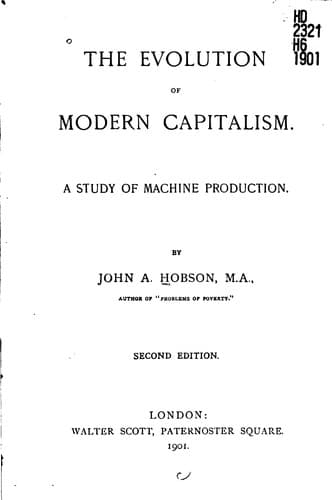
The Evolution of Modern Capitalism: A Study of Machine ProductionHobson, J. A. (John Atkinson)
History
The Evolution of Modern Capitalism: A Study of Machine Production
Hobson, J. A. (John Atkinson)
Capitalism; Industries -- History; Machinery in the workplace
Mr. Bowley points out that "after each of the great railway booms of
the century, for instance in England about 1847, in America before
1857 and 1873, in India in 1878, and on the Continent in 1873, the
collapse has been very violent; for the materials are bought at
exaggerated prices; the weekly wage during construction is enormous;
no return is obtained till the whole scheme, whose carrying out
probably lasts many years, is complete."
A great deal of this railway enterprise meant over-production of forms
of transport-capital and a corresponding withholding of current
consumption. In other words, a large part of the "savings" of England,
Germany, America, etc., invested in these new railways, were
sterilised; they were not economically needed to assist in the work of
transport, and many of them remain almost useless, as the quoted value
of the shares testifies. It is not true, as is sometimes suggested,
that after a great effort in setting on foot such gigantic
enterprises, a collapse is economically necessary. If the large
incomes and high wages earned in the period prior to 1873, when
capital and labour found full employment in these great enterprises,
had been fully applied in increased demand for commodities and an
elevated standard of consumption, much of the new machinery of
transport, which long stood useless, would have been required to
assist in forwarding goods to maintain the raised standard of
consumption. This argument, of course, assumes that ignorance or fraud
have not caused a misdirection of investment. There is no evidence to
indicate that the vast sums invested in 1869-72 in railway enterprise
could have found any safer or more remunerative investment. It is the
overflow of "savings," after all capital economically needed to carry
on the work of production to supply steady current wants has been
secured, that flows into the hands of speculative company-promoters.
Such savings are not diverted from safe and useful forms of
investment, they are "savings" which ought never to have been
attempted, for they have no economic justification in the needs of
commerce, as is proved by results.
Public-domain text, read in full here on John Shaqi.
Reviews
Reviews
No reviews yet
Be the first to share your thoughts on this work.
Elsewhere in the archive
Join the Discussion
Join the discussion
Sign in to leave a comment or review.
Sign InorCreate an account