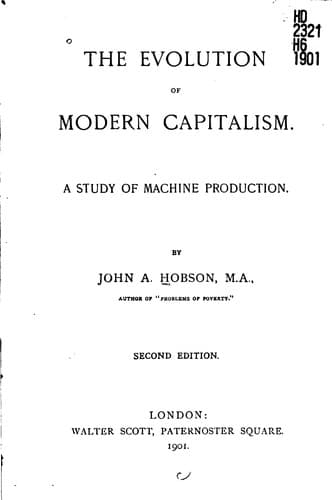
The Evolution of Modern Capitalism: A Study of Machine ProductionHobson, J. A. (John Atkinson)
History
The Evolution of Modern Capitalism: A Study of Machine Production
Hobson, J. A. (John Atkinson)
Capitalism; Industries -- History; Machinery in the workplace
§ 7. Machinery thus figures as the efficient cause of industrial
disease, but the real responsibility does not rest on the shoulders of
the inventor of new machinery, or of the manufacturer, but of the
consumer.
The root-evil of depressed trade is under-consumption.[157] If a
quantity of capital and labour is standing idle at the same time, in
all or in the generality of trades, the only possible reason why they
remain unemployed is that there is no present demand for the goods
which by co-operation they are able to produce.
English economists, most of whom, ever since the time of J.B. Say,
have denied the possibility of the condition of general over-supply
which is seen to exist in depressed trade, are contented to assume
that there can be no general over-supply because every one who
produces creates a corresponding power to consume. There cannot, it is
maintained, be too much machinery or too much of any form of capital
provided there exists labour to act with it; if this machinery,
described as excessive, is set working, some one will have the power
to consume whatever is produced, and since we know that human wants
are insatiable, too much cannot be produced. This crude and
superficial treatment, which found wide currency from the pages of
Adam Smith and McCulloch, has been swallowed by later English
economists, unfortunately without inquiring whether it was consistent
with industrial facts. Since all commerce is ultimately resolvable
into exchange of commodities for commodities, it is obvious that every
increase of production signifies a corresponding increase of power to
consume. Since there exists in every society a host of unsatisfied
wants, it is equally certain that there exists a desire to consume
everything that can be produced. But the fallacy involved in the
supposition that over-supply is impossible consists in assuming that
the power to consume and the desire to consume necessarily co-exist in
the same persons.
Public-domain text, read in full here on John Shaqi.
Reviews
Reviews
No reviews yet
Be the first to share your thoughts on this work.
Elsewhere in the archive
Join the Discussion
Join the discussion
Sign in to leave a comment or review.
Sign InorCreate an account