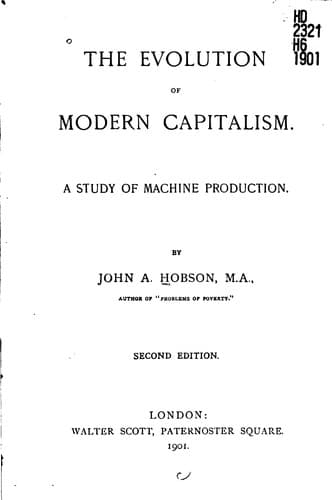
The Evolution of Modern Capitalism: A Study of Machine ProductionHobson, J. A. (John Atkinson)
History
The Evolution of Modern Capitalism: A Study of Machine Production
Hobson, J. A. (John Atkinson)
Capitalism; Industries -- History; Machinery in the workplace
In the case of a glut of cotton goods due to an increased application
of machinery, the spinners and manufacturers have the power to consume
what is produced, while a mass of starving, ill-clad beings in Russia,
East London--even in Manchester--may have the desire to consume these
goods. But since these latter are not owners of anything which the
spinners and manufacturers wish to consume or to possess, the exchange
of commodities for commodities cannot take place. But, it will be
said, if the Lancashire producers desire to consume anything at all,
those who produce such articles of desire will have the power, and
possibly the desire, to consume more cotton goods, or at any rate the
desire to consume something produced by other people who will have
both power and desire to consume cotton goods. Thus, it will be said,
the roundabout exchange of commodities for commodities must be brought
about. And this answer is valid, on the assumption that the Lancashire
producers desire to consume an equivalent of the goods they produce.
But let us suppose they do not desire to do so. The reply that since
human wants are insatiable every one with power to consume must have
desire to consume, is inadequate. In order to be operative in the
steady maintenance of industry the desire to consume must be a desire
to consume _now_, to consume continuously, and to consume to an extent
corresponding with the power to consume.
Let us take the Lancashire trade as a test case. Evidently, there
could be no superfluous capital and labour in Lancashire trade if the
cotton-spinners, manufacturers and their operatives, increased their
own consumption of cotton goods to correspond with every increase of
output.
But if they do not do this, they can only make good and maintain
their capital and labour in employment by persuading others to
increase their consumption of cotton goods. How can they do this? If,
instead of desiring to consume more cotton goods, the Lancashire
employers and operatives desire to consume, and do actually consume,
more hardware, houses, wine, etc., then the increased consumption of
these things, raising their prices and so stimulating their
production, and distributing a larger purchasing-power among the
capitalists and operatives engaged in producing the said hardware,
houses, wine, etc., will enable the latter to consume more cotton
goods, and if these desire to do so, their effective demand will
maintain the new capital and labour employed in Lancashire trade.
Public-domain text, read in full here on John Shaqi.
Reviews
Reviews
No reviews yet
Be the first to share your thoughts on this work.
Elsewhere in the archive
Join the Discussion
Join the discussion
Sign in to leave a comment or review.
Sign InorCreate an account