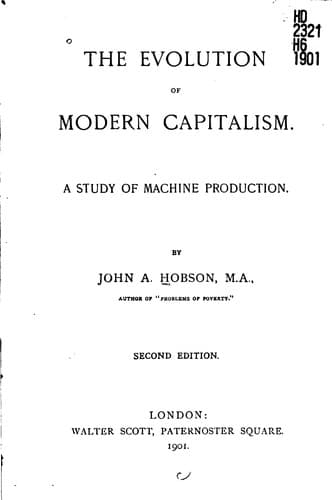
The Evolution of Modern Capitalism: A Study of Machine ProductionHobson, J. A. (John Atkinson)
History
The Evolution of Modern Capitalism: A Study of Machine Production
Hobson, J. A. (John Atkinson)
Capitalism; Industries -- History; Machinery in the workplace
§ 8. The process of "Saving" has received but scant attention from
economic writers. Jevons appears to have held that superfluous food
and other necessary consumptive goods, in whosoever hands they were,
constituted the only true fund of capital in a community at any given
time. Sidgwick also holds that all "Savings" are in the first instance
"food." That this is not the case will appear from the following
example:--A self-sufficing man produces daily for his daily
consumption a quantity of food, etc., denoted by the figure 10. 5 of
this is necessary and 5 superfluous consumption. This man, working
with primitive tools, discovers an implement which will greatly
facilitate his production, but will cost 4 days' labour to make. Three
alternatives are open to him. He may spend half his working day in
producing the strictly necessary part of his previous consumption, 5,
and devote the other half to making the new implement, which will be
finished in 8 days. Or he may increase the duration of his working day
by one quarter, giving the extra time to the making of his new
implement, which will be finished in 16 days. Or lastly, he may
continue to produce consumptive goods as before, but only consume half
of them, preserving the other half for 8 days, until he has a fund
which will suffice to keep him for 4 continuous days, which he will
devote to making the new implement. If he adopts the first
alternative, he simply changes the character of his production,
producing in part of his working day future goods instead of present
consumptive goods. In the second he creates future goods by extra
labour. In the third case only does the "saving" or new "capital" take
as its first shape food. In the same way a community seeking to
introduce a more "roundabout" method of production requiring new
plant, or seeking to place in the field of industry a new series of
productive processes to satisfy some new want, may achieve their
object by "saving" food, etc., or by changing for awhile the character
of their production, or by extra labour. Thus new capital, whether
from the individual or the community point of view, may take either
"food" or any other material form as its first shape.
Since "savings" need not take the shape of food or any article capable
of immediate consumption, Adam Smith and J.S. Mill are clearly wrong
when they urge in terms almost identical[158] that what is saved is
necessarily consumed, and consumed as quickly as that which is spent.
The antithesis of saving and spending shows these writers, and the
bulk of English economists who follow them, are misled, because they
regard "saving" as doing something with money, and do not sufficiently
go behind the financial aspect of putting money into a bank.
Public-domain text, read in full here on John Shaqi.
Reviews
Reviews
No reviews yet
Be the first to share your thoughts on this work.
Elsewhere in the archive
Join the Discussion
Join the discussion
Sign in to leave a comment or review.
Sign InorCreate an account