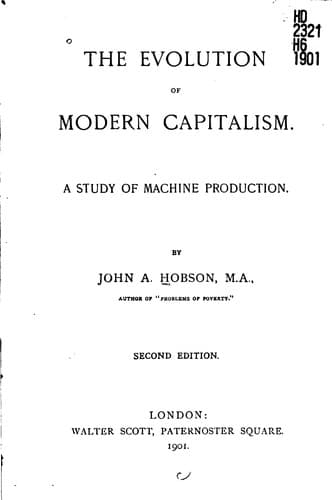
The Evolution of Modern Capitalism: A Study of Machine ProductionHobson, J. A. (John Atkinson)
History
The Evolution of Modern Capitalism: A Study of Machine Production
Hobson, J. A. (John Atkinson)
Capitalism; Industries -- History; Machinery in the workplace
A closer analysis of saving yields the result that, except in one of
the simple cases taken in our example above, where "saving" implied
withholding consumable goods from present consumption, every act of
saving in a complex industrial society signifies making, or causing to
be made, forms of capital which are essentially incapable of present
consumption--_i.e._, future or productive goods.
Each member of an industrial community receives his money income as
the market equivalent of value created in goods or services by the
requisites of production, land, capital, labour which he owns. For
every £1 paid as income an equivalent quantity of material or
non-material wealth has been already created.
Let A be the owner of a requisite of production, receiving £500 a year
as income in weekly payments of £10. Before receiving each £10 he has
caused to come into existence an amount of wealth which, if material
goods, may or may not be still in existence; if services, has already
been consumed. It is evident that A may each week consume £10 worth of
goods and services without affecting the general condition of public
wealth. A, however, determines to consume only £5 worth of goods and
services each week, and puts the other £5 into the bank. Now what
becomes of the £5 worth of goods and services which A might have
consumed, but refused to consume? Do they necessarily continue to
exist so long as A is credited with the money which represents their
"saving"; if so, in what form? In other words, what actually takes
place in the world of commerce when money income is said to be saved,
what other industrial facts stand behind the financial fact of A
depositing part of his income in the bank as "savings"?
To this question several answers are possible.
(1) B, a spendthrift owner of land or capital, wishing to live beyond
his income, may borrow from the bank each £5 which A puts in,
mortgaging his property. In this case B spends what A might have
spent; B's property (former savings perhaps?) falls into A's hands. A
has individually effected a "saving" represented by tangible property,
but as regards the community there is no saving at all, real or
apparent.
(2) C, a fraudulent promoter of companies, may by misrepresentation
get hold of A's saved money, and may spend it for his own enjoyment,
consuming the goods and services which A might have consumed, and
giving to A "paper" stock which figures as A's "savings." Here A has
individually effected no saving.
Public-domain text, read in full here on John Shaqi.
Reviews
Reviews
No reviews yet
Be the first to share your thoughts on this work.
Elsewhere in the archive
Join the Discussion
Join the discussion
Sign in to leave a comment or review.
Sign InorCreate an account