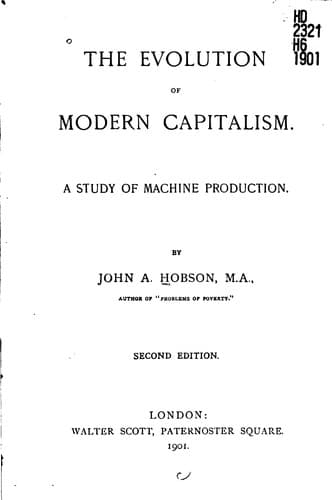
The Evolution of Modern Capitalism: A Study of Machine ProductionHobson, J. A. (John Atkinson)
History
The Evolution of Modern Capitalism: A Study of Machine Production
Hobson, J. A. (John Atkinson)
Capitalism; Industries -- History; Machinery in the workplace
From the point of view of the community there is no real saving (C has
consumed instead of A), but so long as the "stock" has a market value
there is an apparent saving. To this category belongs the "savings"
effected if A lends his money to a government to be spent on war. From
the standpoint of the community there is no saving (unless the war be
supposed to yield an asset of wealth or security), but A's paper stock
represents his individual saving. A's "saving" is exactly balanced by
the spending of the community in its corporate capacity, A receiving a
mortgage upon the property of the community.[159]
(3) D and E, manufacturers or traders, engaged in producing luxuries
which A used to buy with his £5 before he took to saving, finding
their weekly "takings" diminished and being reduced to financial
straits, borrow A's "savings" in order to continue their business
operations, mortgaging their plant and stock to A. So long as, with
the assistance of A's money, they are enabled to continue producing,
what they produce is over-supply, not needed to supply current
consumption, assuming the relation between spending and saving in the
other members of the community remains unaltered. This over-supply is
the material representative of A's "savings." So far as real capital
is concerned there is no increase by A's act of saving, rather a
decrease, for along with the net reduction in the consumption of
luxuries on the part of the community due to A's action, there must be
a fall in the "value" of the capital engaged in the various processes
of producing luxuries, uncompensated by any other growth of values.
But by A's "saving" new forms of capital exist which bear the
appearance of capital, though in reality they are "over-supply." These
empty forms represent A's saving. Of course A, with full knowledge of
the facts, would only lend to D and E up to the real value of their
mortgaged capital. When this point was reached D and E could get no
further advances, and their stock and plant would pass into A's hands.
From the point of view of the community A's action has resulted in the
creation of a number of material forms of capital which, so long as
the existing relations between the community's production and
consumption continue, stand as over-supply.
Public-domain text, read in full here on John Shaqi.
Reviews
Reviews
No reviews yet
Be the first to share your thoughts on this work.
Elsewhere in the archive
Join the Discussion
Join the discussion
Sign in to leave a comment or review.
Sign InorCreate an account