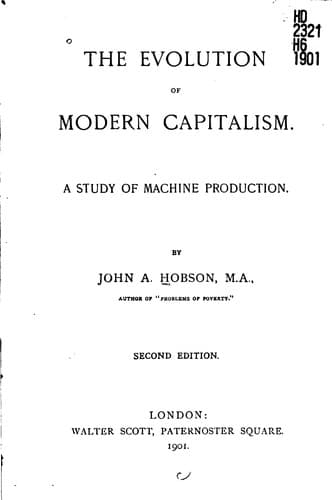
The Evolution of Modern Capitalism: A Study of Machine ProductionHobson, J. A. (John Atkinson)
History
The Evolution of Modern Capitalism: A Study of Machine Production
Hobson, J. A. (John Atkinson)
Capitalism; Industries -- History; Machinery in the workplace
goods, and any stock or plant in excess of this amount figures as
waste forms of capital or over-supply. F then is the quantitative
regulator of A, B, C, D, E.[163] Nor is the accuracy of this statement
impaired by the speculative character of modern trade. Speculative
merchants or manufacturers may set up business at D or C and provide
themselves with stock and machinery to start with, but unless they
meet or create a growing demand of consumers their capital is waste,
or else if they succeed in getting trade it is at the expense of other
members of the trade, and their capital is made productive by
negativing the capital of other traders.
§ 11. The truth here insisted on, that an exact quantitative relation
exists between the amount of stock and plant, severally and
collectively, required at the different points A, B, C, D, E, and that
the amount economically serviceable at each point is determined by the
quantity of current consumption, would seem self-evident. But though
this has never been explicitly denied, the important results following
from its recognition have been obscured and befogged by several
conceptions and phrases relating to capital which have found
acceptance among English economists.
Chief and foremost among these errors is the framing of a definition
of capital so as to exclude the clear separation of productive goods
and machinery, the economic means, from consumptive goods, the
economic end. So long as a definition of capital is taken which
includes any consumptive goods whatsoever, two results follow. One is
a hopeless confusion in the commercial mind, for in commerce
everything is capital which forms the stock or plant of a commercial
firm, and nothing is capital which does not form part of such stock or
plant. Secondly, to include under capital the food in the possession
of productive labourers or any other consumptive goods is an
abandonment of the idea of consumption as the economic end and a
substitution of production.
Public-domain text, read in full here on John Shaqi.
Reviews
Reviews
No reviews yet
Be the first to share your thoughts on this work.
Elsewhere in the archive
Join the Discussion
Join the discussion
Sign in to leave a comment or review.
Sign InorCreate an account