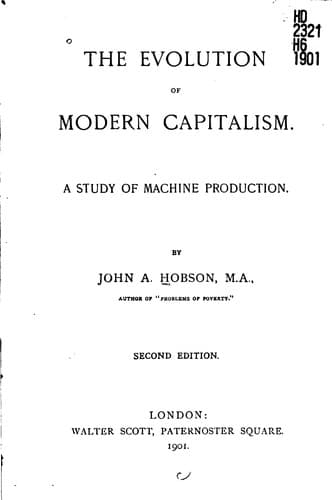
The Evolution of Modern Capitalism: A Study of Machine ProductionHobson, J. A. (John Atkinson)
History
The Evolution of Modern Capitalism: A Study of Machine Production
Hobson, J. A. (John Atkinson)
Capitalism; Industries -- History; Machinery in the workplace
If we follow Böhm-Bawerk and the Austrian economists in definitely
refusing to include the consumptive goods of labourers as
capital,[164] we get a conception of capital which is at once in
accordance with the universal conception of commercial men, and which
enables us to realise the vital relation between capital and
consumption. We now see Capital in the form of stock and plant at each
point in the industrial machine deriving its use and value from its
contribution to the end, Consumption, and dependent for its quantity
upon the quantity of Consumption. We have seen that a demand for
commodities is the true and exact determinant of the quantity of
capital at each industrial stage. It is therefore the determinant of
the aggregate of wealth which can function as useful forms of capital
in the industrial community at any given time. The aggregate of plant
and stock which constitute the material forms of capital at the points
A, B, C, D, E must in a properly adjusted state of industry have an
exact quantitative relation to the consumption indicated by F. If F
increases, the quantity of forms of capital at A, B, C, D, E may
severally and collectively increase; if F declines, the useful forms
of capital at each point are diminished. Since we have seen that the
sole object of saving from the social point of view is to place new
forms of capital at one of the points A, B, C, D, E, it is evident
that the amount of useful saving is limited by the rate of
consumption, or financially, by the amount of "spending." Where there
is an improvement in the general productive power of a community, only
a certain proportion of that increased power can be economically
applied to "saving"--_i.e._, to the increase of forms of capital; a
due proportion must go to increased spending and a general rise in
consumption.
§ 12. This will hardly be disputed, except by those who still follow
Mill in maintaining that the whole of the current production could be
"saved," with the exception of what was required to support the
efficiency of labour, a doctrine to which even he could only give
passing plausibility by admitting that the increased savings which
resulted from an attempt to do this would take the shape of luxuries
consumed by the said labourers--that is to say, would not be "savings"
at all, but a transfer of "spending" from one class to another.[165]
If capital be confined to commercial capital, and "saving" to the
establishment of the forms of such capital, no one will deny that the
quantity of "saving" which can be effectually done by a community at
any time depends upon the current rate of consumption, or that any
temporary increase of such saving must be justified by a corresponding
future increase in the proportion of spending.[166]
Public-domain text, read in full here on John Shaqi.
Reviews
Reviews
No reviews yet
Be the first to share your thoughts on this work.
Elsewhere in the archive
Join the Discussion
Join the discussion
Sign in to leave a comment or review.
Sign InorCreate an account