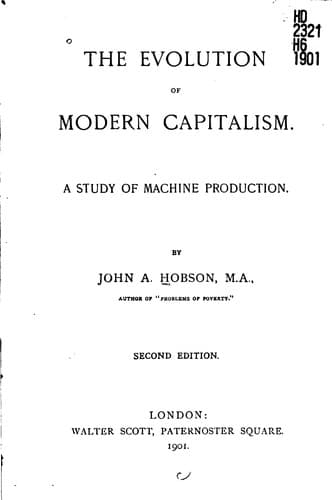
The Evolution of Modern Capitalism: A Study of Machine ProductionHobson, J. A. (John Atkinson)
History
The Evolution of Modern Capitalism: A Study of Machine Production
Hobson, J. A. (John Atkinson)
Capitalism; Industries -- History; Machinery in the workplace
Some of the labour stored and the capital established in the
construction of harbours, the drainage of land, the construction of
scientific instruments, and other works of durable nature and indirect
service, may not be represented in consumptive goods for centuries.
Admitting this, it may be urged, can any limits be set to present
"saving" and its storage in forms of capital, provided those forms be
selected with a due regard to a sufficiently distant future? The answer
is that only under two conditions could an indefinitely large amount of
present "saving" be justified. The first condition is that an unlimited
proportion of this "saving" can be stored in forms which are practically
imperishable; the second condition is that our present foresight shall
enable us to forecast the methods of production and consumption which
shall prevail in the distant future. In fact neither of these conditions
exists. However much present "saving" we stored in the most enduring
forms of capital with which we are acquainted--_e.g._, in the permanent
way of railroads, in docks, in drainage and improvement of land, a large
proportion of this "saving" would be wasted if the consumption it was
destined to subserve was postponed for long.[167] Neither can we predict
with any assurance that the whole value of such "savings" will not have
disappeared before a generation has elapsed by reason of changes in
industrial methods.
The amount of present "saving" which is justified from the point of
view of the community is strictly limited. We cannot forecast the
demand of our twentieth generation of descendants, or the industrial
methods which will then prevail; we do not even know whether there
will be a twentieth generation; there are certain large inevitable
wastes in postponed consumption by reason of the perishability of all
material forms of wealth, or the abstraction of them by others than
those for whose use they were intended. Moreover, we do not believe it
would be good for our descendants to have the enjoyment of excessive
wealth without a corresponding personal effort of producing, nor would
it be good for us to exert effort without some proximate and
corresponding enjoyment. The limits of individual life rightly demand
that a large proportion of individual effort shall fructify in the
individual life.
Public-domain text, read in full here on John Shaqi.
Reviews
Reviews
No reviews yet
Be the first to share your thoughts on this work.
Elsewhere in the archive
Join the Discussion
Join the discussion
Sign in to leave a comment or review.
Sign InorCreate an account