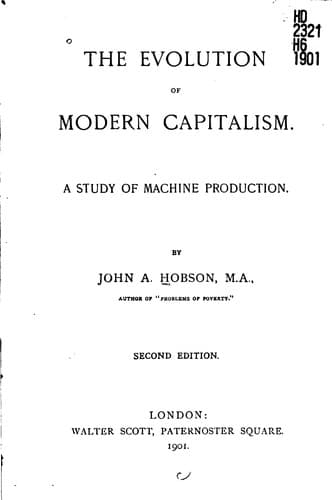
The Evolution of Modern Capitalism: A Study of Machine ProductionHobson, J. A. (John Atkinson)
History
The Evolution of Modern Capitalism: A Study of Machine Production
Hobson, J. A. (John Atkinson)
Capitalism; Industries -- History; Machinery in the workplace
Thus there are practical limits set upon the quantity of "saving"
which can be usefully effected by extending the interval between
effort and enjoyment. If the right period be exceeded the risk and
waste is too great. The analogy of gardening adduced by Ruskin is a
sound one.[168] By due care and the sacrifice of bud after bud the
gardener may increase the length of the stem and the size of the
flower that may be produced. He may be said to be able to do this
indefinitely, but if he is wise he knows that the increased risks of
such extension, not to mention the sacrifice of earlier units of
satisfaction, impose a reasonable limit upon the procrastination. The
proportion of "saving" which may be and is applied to establish
late-fructifying forms of wealth, differs not only with the different
developments of the industrial arts, but with the foresight and moral
character of the race and generation. As our species of civilisation
advances, and the demand for complex luxuries and the arts of
supplying them advance, a larger amount of "roundabout" production
becomes possible, and as regard for the future generations advances,
more capital will be put into forms which fructify for them. But at
the present in any given community there is a rational and a
necessary limit to the quantity of "saving" which can be applied to
such purposes.
Secondly, we find that in fact the surplus "saving" over and above
what is needed to provide the necessary forms of capital to assist in
satisfying current consumption is not absorbed in making provision for
distant future consumption by more "roundabout methods." Much of it
goes into a mere increase of the number of existing forms of capital
whose _raison d'être_ lies in the satisfaction of present or
immediately future wants. The multiplication of cotton-spinning-mills,
of paper-mills, of breweries, ironworks, has gone on far faster than
the growth of current consumption. This increase of productive
machinery has not in fact been able to force such an increase of
consumption as gives adequate employment to these new forms of
machinery and to the labour which is at hand to work them.
Public-domain text, read in full here on John Shaqi.
Reviews
Reviews
No reviews yet
Be the first to share your thoughts on this work.
Elsewhere in the archive
Join the Discussion
Join the discussion
Sign in to leave a comment or review.
Sign InorCreate an account