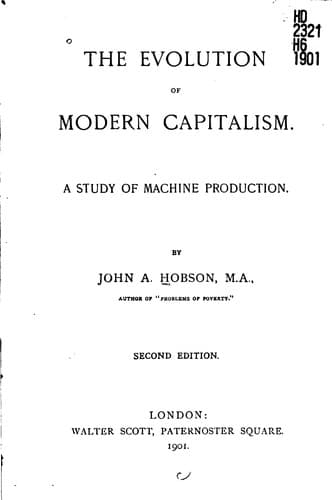
The Evolution of Modern Capitalism: A Study of Machine ProductionHobson, J. A. (John Atkinson)
History
The Evolution of Modern Capitalism: A Study of Machine Production
Hobson, J. A. (John Atkinson)
Capitalism; Industries -- History; Machinery in the workplace
by "spending" deplete its capital, while it cannot increase its
"spending" without at the same time increasing its real capital,[169]
it will doubtless be profitable to a progressive community to reduce
its consumption for a while below the normal proportion in order to
fully utilise new discoveries in the industrial arts which shall
justify in the future increased consumption.
But with this necessary qualification it is true that a community
cannot exceed in the direction of spending. But the balance may lean
the other way. A community may "save too much," that is to say, it may
establish a larger quantity of productive machinery and goods than is
required to maintain current or prospective consumption. What is to
prevent a community consisting of a vast number of individuals with no
close knowledge of one another's actions, desires, and intentions,
making such a miscalculation as will lead them to place at each of the
points A, B, C, D, E, and in all or most branches of industry, a
larger quantity of forms of capital than are required?
It is said that the harmony which subsists between the social interest
and the self-interest of individuals will prevent this, or, in other
words, that individuals would find that if they attempted to unduly
increase the aggregate of capital beyond what was socially
advantageous in view of the community's consumption, it would not pay
them to do so. Is this true?
An individual working entirely for himself, whose capital lay in his
tools and his raw or unfinished commodities, would never increase the
latter unduly. A socialist community properly managed would never add
to its stock of machinery or increase the quantity of its raw
materials or unfinished goods, so as to leave any machines unused or
half used, or any goods unnecessarily occupying warehouse room and
deteriorating in quality. But when competition of individual interests
comes in there is no such security.
It may pay individuals to build new factories and put in new machinery
where it would not pay the community to do so, were it the sole owner
of the means of production.
Public-domain text, read in full here on John Shaqi.
Reviews
Reviews
No reviews yet
Be the first to share your thoughts on this work.
Elsewhere in the archive
Join the Discussion
Join the discussion
Sign in to leave a comment or review.
Sign InorCreate an account