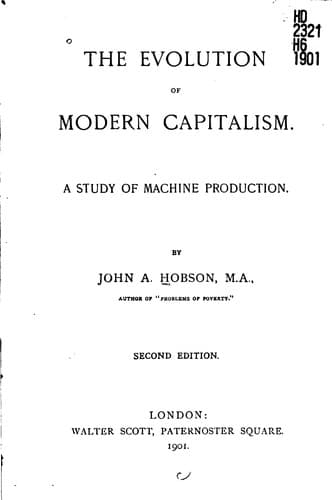
The Evolution of Modern Capitalism: A Study of Machine ProductionHobson, J. A. (John Atkinson)
History
The Evolution of Modern Capitalism: A Study of Machine Production
Hobson, J. A. (John Atkinson)
Capitalism; Industries -- History; Machinery in the workplace
§ 13. It is not therefore correct to say that the rate of production
determines the rate of consumption just as much as the rate of
consumption determines the rate of production. The current productive
power of capital and labour places a maximum limit upon current
consumption, but an increase of productive power exercises no
sufficient force to bring about a corresponding rise in consumption.
Just as in a particular trade--_e.g._, the Lancashire cotton trade, an
excess of "saving" may be applied to the establishment of mills and
machinery which cannot be kept working because there is no market for
their output, so it is with trade in general. It is not true that the
inflation of capital in the Lancashire trade is due to a misdirection
which implies a lack of capital in some other branch of industry. In a
period of depression like the present every other important branch of
industry displays the same symptoms of excessive plant, over-supply of
stock, irregular and deficient employment of labour, though not to the
same extent. Nor is there any _à priori_ reason why there should not
be from time to time such general maladjustment. If ignorance and
miscalculation leads to the investment of too much capital in, say,
the cotton and iron industries, it is not unreasonable to suppose that
in a complex industrial society there should be such general
miscalculation of the right proportion between saving and spending
that too much should be saved at certain periods. That is to say,
turning again to the diagram of industry, just as it is admitted that
miscalculation may induce too much capital to be placed at A or B or
C, and too little at one of the other points of production, disturbing
the harmonious ordering of the parts of capital, so likewise there may
be a maladjustment of the proportion between A, B, C, D, E, the
aggregate of forms of capital, and F, the aggregate of consumption,
between "saving" and "spending." Now if it be admitted that such
maladjustment is possible, the balance can only lean one way. There
cannot be too little saving to furnish current consumption, taking the
industrial community as a whole, for it is impossible to increase the
rate of consumption, F, faster than the increase of the rate of
current production: any increase of the purchase of shop-goods by
raising prices and circulating more money down the paths of production
stimulates and strains the sinews of production, and if the existing
machinery of production is inadequate it supplies a motive-power to
increase "saving." In no case can a community consume faster than it
produces. An individual can do so by living on his capital, a nation
may do so for a time by living upon its capital, giving to other
nations by means of an increased debt a lien upon its future wealth.
But a whole industrial community can never live upon its capital, can
never in the literal sense of the term "spend too much." This
statement requires a single qualification. While a community can never
Public-domain text, read in full here on John Shaqi.
Reviews
Reviews
No reviews yet
Be the first to share your thoughts on this work.
Elsewhere in the archive
Join the Discussion
Join the discussion
Sign in to leave a comment or review.
Sign InorCreate an account