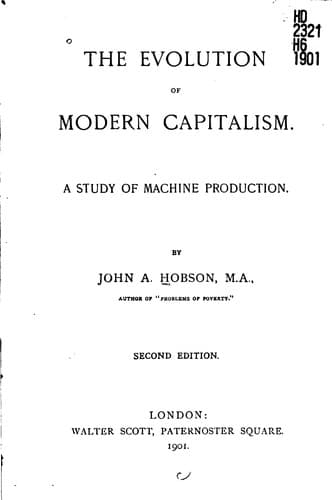
The Evolution of Modern Capitalism: A Study of Machine ProductionHobson, J. A. (John Atkinson)
History
The Evolution of Modern Capitalism: A Study of Machine Production
Hobson, J. A. (John Atkinson)
Capitalism; Industries -- History; Machinery in the workplace
Secondly, over-production or a general glut is only an external phase
or symptom of the real malady. The disease is under-consumption or
over-saving. These two imply one another. The real income of a
community in any given year is divisible into two parts, that which is
produced and consumed, that which is produced and not consumed--_i.e._,
is saved. Any disturbance in the due economic proportion of these two
parts means an excess of the one and a defect of the other. All
under-consumption therefore implies a correspondent over-saving. This
over-saving is embodied in an excess of machinery and goods over the
quantity economically required to assist in maintaining current
consumption. It must, however, be remembered that this over-saving is
not measured by the quantity of new mills, machinery, etc., put into
industry. When the mechanism of industry is once thoroughly congested,
over-saving may still continue, but will be represented by a
progressive under-use of existing forms of capital, that unemployment
of forms of capital and labour which makes trade depression.
An increased quantity of saving is requisite to provide for an
expected increase of consumption arising from a growth of population
or from any other cause. Such increased saving is of course not
over-saving. The proportion, as well as the absolute amount of the
community's income which is saved, may at any time be legitimately
increased, provided that at some not distant time an increased
proportion of the then current income be consumed. If in a progressive
community the proportion of "saving" to consumption, in order to
maintain the current standard of living with the economic minimum of
"forms" of capital, be as 2 to 10, the proportion of saving in any
given year may be raised to 3 to 9, in order to provide for a future
condition in which saving shall fall to 1 to 11. Such increased
"saving" will not be over-saving; the forms of capital in which it is
embodied will not compete with previously existing forms so as to
bring down market prices. The efforts which take the form of permanent
improvements of the soil, the erection of fine buildings, docks,
railways, etc., for future use, may provide the opportunity to a
community of increasing the proportion of its savings for a number of
years. But such savings must be followed by an increased future
consumption without a correspondent saving attached to it. The notion
that we can indefinitely continue to increase the proportion of our
savings to our consumption, bounded only by the limit of actual
necessaries of life, is an illusion which places production in the
position of the human goal instead of consumption.
Public-domain text, read in full here on John Shaqi.
Reviews
Reviews
No reviews yet
Be the first to share your thoughts on this work.
Elsewhere in the archive
Join the Discussion
Join the discussion
Sign in to leave a comment or review.
Sign InorCreate an account