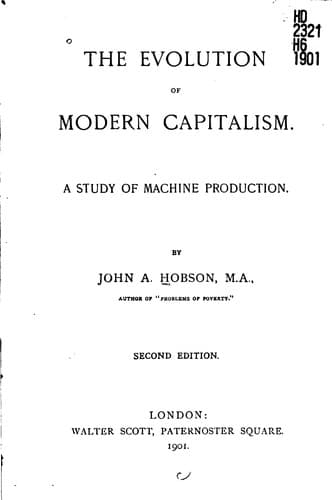
The Evolution of Modern Capitalism: A Study of Machine ProductionHobson, J. A. (John Atkinson)
History
The Evolution of Modern Capitalism: A Study of Machine Production
Hobson, J. A. (John Atkinson)
Capitalism; Industries -- History; Machinery in the workplace
§ 16. Machinery has intensified the malady of under-consumption or
over-saving, because it has increased the opportunities of conflict
between the interests of individuals and those of the community. With
the quickening of competition in machine industries the opportunities
to individuals of making good their new "savings" by cancelling the
old "savings" of others continually grow in number, and as an ever
larger proportion of the total industry falls under the dominion of
machinery, more and more of this dislocation is likely to arise; the
struggles of weaker firms with old machinery to hold their own, the
efforts of improved machinery to find a market for its expanded
product, will continue to produce gluts more frequently, and the
subsequent checks to productive activity, the collapse of businesses,
the sudden displacement of large masses of labour, in a word, all the
symptoms of the malady of "depression" will appear with increased
virulence.
It must be clearly recognised that the trouble is due to a genuine
clash of individual interests in a competitive industrial society,
where the frequent, large, and quite incalculable effects of improved
machinery and methods of production give now to this, now to that
group of competitors a temporary advantage in the struggle. It was
formerly believed that this bracing competition, this free clash of
individual interests, was able to strike out harmony, that the steady
and intelligent pursuit by each of his own separate interest formed a
sure basis of industrial order and induced the most effective and
serviceable disposition of the productive powers of a community.
It now appears that this is not the case, and that the failure cannot
in the main be attributed to an imperfect understanding by individuals
of the means by which their several interests may be best subserved,
but is due to the power vested in individuals or groups of individuals
to secure for themselves advantages arising from improved methods of
production without regard for the vested interests of other
individuals or of society as a whole.
APPENDIX I.
ARE GOODS IN THE POSSESSION OF CONSUMERS CAPITAL?
The question whether food, clothing, etc., which are "capital" so long
as they form part of the stock of a shopkeeper, are to be regarded as
ceasing to be capital when they pass into the possession of consumers
has seldom been definitely faced by English economists. Jevons was
perhaps the first to clearly recognise the issues involved. He
writes:--"I feel quite unable to adopt the opinion that the moment
goods pass into the possession of the consumer they cease altogether
to have the attributes of capital. This doctrine descends to us from
the time of Adam Smith, and has generally received the undoubting
assent of his followers. Adam Smith, although he denied the
possessions of a consumer the name of capital, took care to enumerate
them as part of the stock of the community." (_The Theory of Political
Economy_, 2nd edit., p. 280.)
Public-domain text, read in full here on John Shaqi.
Reviews
Reviews
No reviews yet
Be the first to share your thoughts on this work.
Elsewhere in the archive
Join the Discussion
Join the discussion
Sign in to leave a comment or review.
Sign InorCreate an account