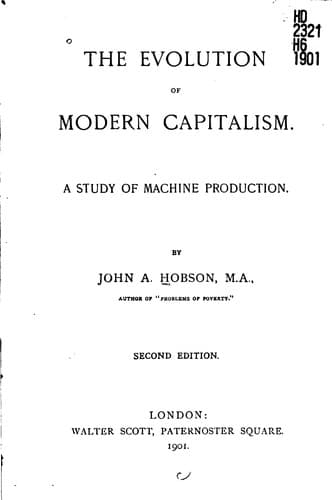
The Evolution of Modern Capitalism: A Study of Machine ProductionHobson, J. A. (John Atkinson)
History
The Evolution of Modern Capitalism: A Study of Machine Production
Hobson, J. A. (John Atkinson)
Capitalism; Industries -- History; Machinery in the workplace
Malthus does not, so far as I can ascertain, face the question. James
Mill alone, among the earlier nineteenth century economists,
definitely excludes labourers' consumptive goods from capital.
(_Principles of Political Economy_, chap. i. § 2.) J.S. Mill is not
equally clear in his judgment. In Bk. I., chap. iv. § 1, food
"destined" for the consumption of productive labourers apparently
ceases to be capital when it is already "appropriated to the
consumption of productive labourers." This position, however, is not
consistent with his later position regarding the unlimited character
of saving, which can only be justified by regarding real wages when
paid as continuing to be capital. Fawcett is vague, but he is disposed
not only to include under capital food which is in the possession of
consumers, but to exclude food which is in the possession of dealers.
"If a man has so much wheat, it is wealth which may at any moment be
employed as capital; but this wheat is not made capital by being
hoarded; it becomes capital when it feeds the labourers, and it cannot
feed the labourers unless it is consumed." (_Manual of Political
Economy_, Bk. I., chap, iv., p. 29.) Among later English writers,
Cairnes, like all holders of the "Wages fund" doctrine, does not
clearly meet the question, "Does the food, etc., forming the real wage
fund which is one part of capital, cease to be capital when it is
actually paid out in wages?" He plays round the question in _Leading
Principles_, Part II., chap. i. Bonamy Price includes consumptive
goods. "It is to be remarked of all this capital, these materials,
implements, and necessaries for the labourers, that they are consumed
and destroyed in the process of creating wealth, some rapidly, some
more slowly. Thus the very purpose of capital is to be consumed and
destroyed; it is procured for that very end." (_Practical Political
Economy_, pp. 103, 104.) Since, he adds a little later, "an article
cannot be declared to be capital or not capital till the purpose it is
applied to is determined," it would appear that flour in the dealer's
hands is not capital, but that it only becomes capital when handed
over to persons who productively consume it. Thorold Rogers appears to
take the same view, holding the food of a country to be part of its
capital irrespective of the consideration in whose hands it is.
(_Political Economy_, p. 61.) Professor Sidgwick appears to regard
"food" consumed by productive labourers as capital. "On this view it
is only so far as the labourer's consumption is distinctly designed to
increase his efficiency that it can properly be regarded as an
investment of capital." (_Principles of Political Economy_, Bk. I.,
chap. v.)
Public-domain text, read in full here on John Shaqi.
Reviews
Reviews
No reviews yet
Be the first to share your thoughts on this work.
Elsewhere in the archive
Join the Discussion
Join the discussion
Sign in to leave a comment or review.
Sign InorCreate an account